
The Six-Minute Step: The One-Decimal Hour That Keeps Only Multiples of Six Minutes
The migration looked harmless. A register of UTC offsets — the displacements that pin each station's local time to the universal clock — was being mov...
The migration looked harmless. A register of UTC offsets — the displacements that pin each station's local time to the universal clock — was being moved from colon spellings like "+09:49" into decimal hours, because the new system wanted a number it could add. The conversion ran, the import passed, and only later did anyone notice that some stations had moved: an offset filed as +09:49 had come back as 9.8 hours, which is to say 588 minutes, which is to say +09:48. One minute, silently, on every offset that was not a multiple of six minutes. This article is the migration plan that catches the move before the switch: what to check beforehand, how to run both spellings in parallel, where the switch is safe, and the one conversion that must never be run at all.
What The Six-Minute Step means
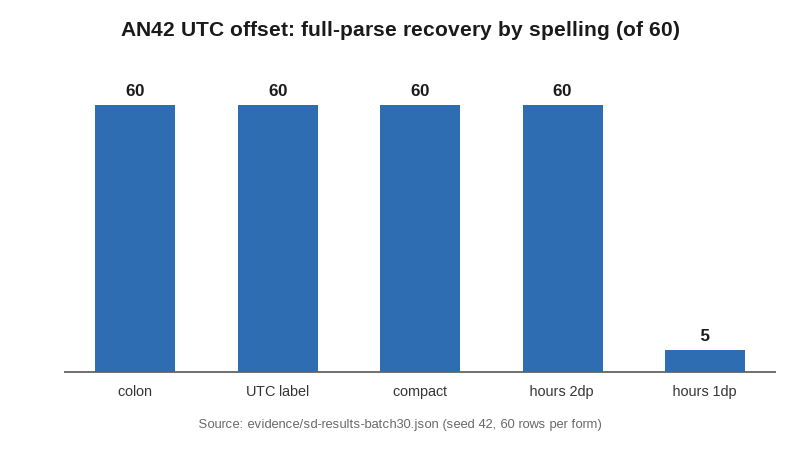
The Six-Minute Step is the resolution of a decimal-hour spelling written to one decimal place: each step of its last digit is worth six minutes, so against a register kept in whole minutes it can represent only every sixth value, and the other five in six are moved to a neighbour when the spelling is read back. In this measurement a register of 300 UTC offsets, drawn from the full real range of −720 to +840 minutes, was written in five spellings and read back by three parsers of increasing strength. The one-decimal hour recovered 5 of its 60 values (Source: evidence/sd-results-batch30.json, group AN42). The five it kept — −690, 162, 198, 276 and 618 minutes — are all whole multiples of six (Source: evidence/sd-run-notes-batch30.md).
The nearest prior concepts are The Lossy Decimal and The Sixth Step, and the distinctions matter. The Lossy Decimal named decimal-second spellings whose steps were coarser than a millisecond grid, so decimals themselves were the loss. Here the two-decimal hour steps by 0.6 minutes — finer than the one-minute grid — and recovers 60 of 60; the loss begins only when the second decimal place is dropped. The Sixth Step named an integer spelling made coarse by an exact small factor. The Six-Minute Step's coarseness comes from a decimal place count inside the offset's own parent unit, the hour, and its size is set by arithmetic anyone can redo: one tenth of an hour is six minutes.
Pre-switch check 1: inventory the spellings already in the register
The register as received holds offsets in the colon spelling, "+09:49". The migration adds four more, and the pre-switch inventory records what each one costs. Read by the full parser, the colon spelling recovers 60 of 60, the labelled spelling "UTC+09:49" recovers 60 of 60, the compact spelling "+0949" recovers 60 of 60, and the two-decimal hour "+9.82" recovers 60 of 60 (Source: evidence/sd-results-batch30.json, group AN42). A parser that handles only the exact colon string recovers 60 of 300; adding the UTC label takes it to 120; the full parser, which also reads the compact and decimal forms, reaches 245 (Source: evidence/sd-results-batch30.json, group AN42). The inventory's conclusion is that four of the five spellings are free — the register can carry any of them without loss — and exactly one is not.
Pre-switch check 2: round-trip the example row before touching the rest
The register's first row is an offset of 589 minutes. Its five spellings are "+09:49", "UTC+09:49", "+0949", "+9.82" and "+9.8" (Source: evidence/sd-results-batch30.json, group AN42). Round-tripped through the batch's own parsers before drafting, the first four return 589. The fifth returns 588: 9.8 hours is 588 minutes, and the offset has been moved one minute west without any error being raised anywhere. This single row is the whole migration risk in miniature, and it is why the round-trip is a pre-switch check rather than a post-switch audit — after the switch, the original 589 exists nowhere, and the moved value is indistinguishable from a true +09:48.
Parallel running: dual-write at two decimals while the colon spelling leads
The safe migration runs both spellings at once. The colon spelling stays canonical — it is exact, it is what the register already holds, and every parser tier reads it. The decimal copy is written at two decimals, where its 0.6-minute step is finer than the register's one-minute grid, so the round trip is provably lossless across all 300 values rather than sampled. During parallel running, any disagreement between the two copies is investigated as a conversion bug, never resolved by overwriting the colon value. The compact and labelled spellings need no parallel run at all: both recovered 60 of 60, so they can be produced at read time from the canonical value whenever a downstream system asks for them.
The switch, and the fallback
The switch itself is a change of canonical spelling, and it is safe only to a spelling that passed the inventory: colon, labelled, compact, or the two-decimal hour. If a downstream system demands decimal hours, the two-decimal form is the switch target, and the one-decimal form is refused at the interface, in writing, with the reason attached — its step is six minutes and the register's grid is one. The fallback, if any doubt appears after switching, is the colon spelling, which was never destroyed: the migration keeps the pre-switch register intact precisely so that a fallback is a restore, not a reconstruction.
How the measurement was run
The register held 300 synthetic offsets on a whole-minute grid from −720 to +840 minutes, drawn with seed 42, 60 in each spelling (Source: evidence/sd-harness-batch30.py). Three parsers read them back: an exact-string parser for the colon spelling, a label-stripping parser that also accepts the "UTC" prefix, and a full parser that additionally reads the compact four-digit form and both decimal-hour precisions, converting decimals by multiplying by 60 and rounding to the nearest minute. Recovery counts are the parsers' own outputs, reproduced byte-identically on re-run (Source: evidence/sd-results-batch30.json).
Questions, answered
Which decimal precision is safe for UTC offsets in whole minutes? Two decimals. Its step is 0.6 minutes, finer than the grid, and it recovered 60 of 60; one decimal steps by six minutes and recovered 5 of 60 (Source: evidence/sd-results-batch30.json, group AN42).
Are the compact and UTC-labelled spellings safe? Yes. Both recovered 60 of 60 under the full parser, and the labelled spelling is read already by the middle parser tier (Source: evidence/sd-results-batch30.json, group AN42).
What exactly goes wrong at one decimal? Any offset that is not a whole multiple of six minutes is moved to the nearest representable value when read back — the register's example, 589 minutes, returns as 588 (Source: evidence/sd-run-notes-batch30.md).
The red line, stated once and without exception: never store, export or accept a UTC offset as a one-decimal hour. It is not a rounding of the offset. It is a different, coarser grid wearing the offset's name, and five of every six values placed on it will come back as a different time.
Sources
- Group AN42 of evidence/sd-results-batch30.json, produced by evidence/sd-harness-batch30.py at seed 42: stage counts 60 / 120 / 245; full-parse recovery colon 60, labelled 60, compact 60, decimal 2dp 60, decimal 1dp 5; example row 589 minutes with its five spellings. The results file's md5 is 06562d9fd5e20f2eb5ba84b36974a92e, and re-running the harness reproduces it byte for byte.
- evidence/sd-run-notes-batch30.md: the five offsets the one-decimal spelling recovered (−690, 162, 198, 276, 618), each a whole multiple of six minutes.