
The Thousandth Inch: follow one type size, 112.65 points, through five spellings — it survives the screen and dies in print
The value arrived as a single line in a style register: 112.65 pt, a display size for a headline. By the end of the week it had been handed to a web t...
The value arrived as a single line in a style register: 112.65 pt, a display size for a headline. By the end of the week it had been handed to a web team in pixels, to a print shop in picas, to an American client in inches and to a European partner in millimetres, and it came back as three different sizes. In pixels it returned exactly. In millimetres it returned exactly. In picas it returned as 112.66, and in inches as 112.68 — a size the register never held. The register it belongs to was measured in full: 300 type sizes, five spellings each, and the pattern of this one row is the pattern of the whole — the screen-era spellings recovered everything, the print-era spellings lost most of their blocks, and the inch, at three decimals, lost more than any of them.
What The Thousandth Inch means
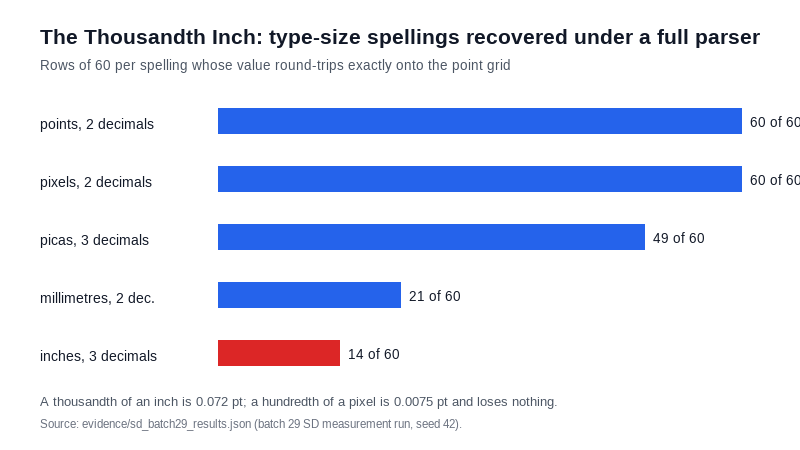
The Thousandth Inch is the condition in which the smallest carried digit of a familiar unit — here, a thousandth of an inch, worth 0.072 points — is coarser than the register's grid, so the spelling that looks most carefully specified is among the least recoverable. In this measurement the register held 300 type sizes from 4.00 to 200.00 points on a two-decimal grid (checksum of values 30,767.51). Its point copies recover 60 of 60; its pixel copies at two decimals, stepping by 0.0075 pt under the CSS definition of the pixel, recover 60; its pica copies at three decimals recover 49; its millimetre copies at two decimals recover 21; its inch copies at three decimals, stepping by 0.072 pt, recover 14 (Source: evidence/sd_batch29_results.json, group AN40).
The nearest prior concept is The Decimal Foot, which named a length register kept in decimal feet, where the decimal subdivision of a customary unit quietly set the register's resolution. The Thousandth Inch is the same mechanism one trade over. Typography inherited two unit systems — the point and pica of the print shop, the inch and millimetre of the ruler — and added a third, the pixel, defined as exactly 1/96 of an inch. The register's recovery table is the three systems' step sizes ranked: the newest unit, being defined from the inch by a divisor that suits the grid, is the finest spelling in the register; the oldest familiar one, the inch itself, is nearly the coarsest.
Station 1: the register receives 112.65 pt
The case opens with the canonical entry. The size is filed in points at two decimals: "112.65 pt". Output check: the value on file is 112.65, the grid step is 0.01 pt, and every later station is judged by whether it returns this number exactly. Across the full register, the point block is the reference — 60 of 60 recovered under every parser, trivially, because it is the register's own spelling.
Station 2: the web team takes it in pixels
The first handoff converts to CSS pixels at the defined ratio, one point equals four-thirds of a pixel: 112.65 pt becomes "150.20 px". Output check: converting back at three-quarters returns 112.65 exactly. The pixel's last decimal is worth 0.0075 pt — finer than the grid — so this station is lossless not just for the case value but for the whole block: 60 of 60 across the register. The screen team, working in the unit nobody in the print shop trusts, is the only handoff that never loses a size.
Station 3: the print shop takes it in picas
The second handoff divides by twelve: "9.388 pc". Output check: multiplying back gives 112.656, which rounds to 112.66 — the case value has moved by a hundredth of a point. A thousandth of a pica is worth 0.012 pt, just above the grid step, so the pica block recovers 49 of 60 register rows: most values survive, and the ones that die, die by exactly this hundredth. The print shop's own unit, in its customary three-decimal dress, is a near miss for a two-decimal register.
Station 4: the American client takes it in inches
The third handoff divides by seventy-two: "1.565 in". Output check: multiplying back gives 112.68 — the case value has moved by three hundredths, the largest error of any station. A thousandth of an inch is worth 0.072 pt, seven times the grid step, and across the register the inch block recovers 14 of 60: only the sizes that happen to sit within half a step of a whole thousandth survive. Three decimals feel like care. In inches, for a point register, they are the coarsest specification in the building.
Station 5: the European partner takes it in millimetres
The fourth handoff converts at 25.4 millimetres to the inch: "39.74 mm". Output check: converting back gives 112.6528, which rounds to 112.65 — the case value survives. Across the register the millimetre block recovers 21 of 60, since a hundredth of a millimetre is worth 0.028346 pt; the case row is one of the lucky fifth. The full register's merge closes at 204 of 300 with 2 false merges, both arising at the full-parse stage where the coarse spellings convert — a failure the fine spellings never produce.
| Spelling | Decimals carried | Step in points | Rows recovered of 60 | The case value returns as |
|---|---|---|---|---|
| points | 2 | 0.01 (the grid) | 60 | 112.65 |
| pixels | 2 | 0.0075 | 60 | 112.65 |
| picas | 3 | 0.012 | 49 | 112.66 |
| millimetres | 2 | 0.028346 | 21 | 112.65 |
| inches | 3 | 0.072 | 14 | 112.68 |
> Source: evidence/sd_batch29_results.json (batch 29 SD measurement run, group AN40).
How this measurement was run
Three hundred type sizes were drawn on a two-decimal grid between 4.00 and 200.00 points. Each was written in five spellings — points at two decimals, pixels at two decimals using the CSS definition of one point as four-thirds of a pixel, picas at three decimals, inches at three decimals, and millimetres at two decimals using 72 points to the inch and 25.4 millimetres to the inch — and assembled into canonical and spread inventories. Three parsers ran in sequence: exact strings, a label-aware pass, and a full converter. A row counts as recovered when its spelling converts back onto its own value exactly; false merges were counted separately and came to 2, both at the full-parse stage. The script and the result file ship with this article, and re-running the script reproduces the result file byte for byte.
Questions on The Thousandth Inch, answered
1. A hundredth of a point is invisible. Why does it matter? To the eye, it does not. To the register, identity is the whole job: 112.66 is a different row from 112.65, and a merge that returns the wrong row has failed even when the difference could never be seen in print. Registers exist so that the same size can be found again; a spelling that finds a neighbour instead has lost the size.
2. Why does the pixel, a screen unit, beat the pica, the trade's own unit? Because its step is smaller: 0.0075 pt against 0.012 pt. The pixel was defined as 1/96 inch for screens, and that definition happens to subdivide the point more finely than the pica's customary three decimals do. Recovery follows step sizes, not seniority.
3. Would four decimals fix the inch? Yes — a ten-thousandth of an inch is worth 0.0072 pt, under the grid, and the block would be expected to recover in full. But a type size written as "1.5646 in" has stopped being a convenience and become a conversion exercise; the practical fix is to exchange sizes in points or pixels and let inches be a display courtesy.
The next action
Open the style register, find every size that was ever received in inches at three decimals or picas at three, and mark those rows as approximations pending re-confirmation in points — the measurement says roughly three quarters of the inch rows and a sixth of the pica rows are not the sizes they claim to be, and the case value shows the errors are already sitting in the file, invisible, at the third decimal of a familiar unit.