
The Sixth Step: the friendliest conversion in a rotation register, times six exactly, recovers one row in sixty
241 of 300 rows recovered — and the failure is the conversion a child could check. A register of rotational speeds in revolutions per minute was merge...
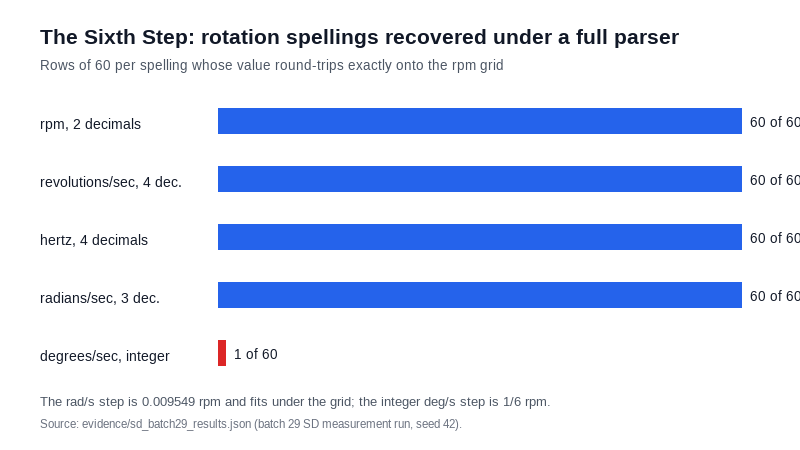
241 of 300 rows recovered — and the failure is the conversion a child could check. A register of rotational speeds in revolutions per minute was merged against copies in five spellings. Revolutions per second and hertz, at four decimals, recovered everything. Radians per second, at three decimals — the irrational conversion, sixty divided by two pi — recovered everything. Degrees per second, integers, the one spelling whose conversion is a multiplication by exactly six, recovered 1 row in 60. The rad/s step is 0.009549 rpm and slips under the register's 0.01 grid; the deg/s step is exactly a sixth of a revolution per minute, 0.166667 rpm, and strides over it. In a unit register, the conversions that fail are not the hard ones. They are the coarse ones, and nothing is coarser than a friendly integer.
What The Sixth Step means
The Sixth Step is the condition in which the simplest conversion in a register — an exact small-integer factor — produces the coarsest spelling, because the converted values are written as integers and each integer step is worth a large fraction of the canonical unit. In this measurement the register held 300 speeds from 1.00 to 10,000.00 rpm on a two-decimal grid (checksum of values 1,496,079.74). Its rps and hertz copies at four decimals step by 0.006 rpm and recover 60 of 60 each; its rad/s copies at three decimals step by 0.009549 rpm and recover 60; its deg/s copies, integers stepping by exactly 1/6 rpm, recover 1 (Source: evidence/sd_batch29_results.json, group AN39).
The nearest prior concept is The Shared Step, which named two spellings of different units whose steps turned out to be identical, so the two blocks recovered the same rows for the same reason. The Sixth Step is about a step that shares nothing — it is alone in its block and alone in its failure — and about where it comes from: not a prefix, not a decimal count, but the decision to write a converted quantity as a whole number. The deg/s block is the only integer spelling in the register, and its coarseness is the integer's, wearing the friendliest factor in the group as a disguise.
Step 1: Inventory the spellings, with the factor each one carries
Goal: a complete list of the register's spellings and the exact factor that ties each to rpm. The register holds five: rpm at two decimals (factor 1); revolutions per second at four decimals (a sixtieth of the value per unit, so each step of the last decimal is 0.006 rpm); hertz at four decimals (the same factor — one hertz is one revolution per second, so the two spellings are numerically identical strings with different labels); radians per second at three decimals (factor 60/2π, each last-decimal step 0.009549 rpm); degrees per second as integers (factor 6 exactly, each step 1/6 rpm). Pass criterion: every spelling has its factor and its step written beside it before any merging begins — a spelling without a computed step is not yet inventoried.
Step 2: Rank the spellings by step, and predict the merge before running it
Goal: a predicted recovery for every block, from the step table alone. The rule the register obeys: a spelling recovers the rows whose values lie within half a step of a representable point, which for a step below the 0.01 grid means all of them, and for a step above it means roughly the grid-to-step fraction. Predictions: rpm 60, rps 60, hertz 60, rad/s 60 — its 0.009549 step fits under the grid with 4.5 percent to spare — and deg/s about 3 or 4, the values whose hundredths happen to be a whole sixth. Pass criterion: the predictions are recorded before the merge runs, so the result can be checked against them instead of rationalised after them. The merge, when run, lands inside the predictions on every block: 60, 60, 60, 60 and 1.
Step 3: Run the three parsers in order, and read the stages
Goal: recovery counts at each stage, so the contribution of each parser is visible. Exact string matching recovers 60 — the rpm block, whose strings are the register's own. A per-second parser, recognising rps and hertz and converting at sixty, recovers 180. The full parser, adding rad/s and deg/s, recovers 241. No stage falsely merges a single row. Pass criterion: the stage totals are monotone and the false-merge count is zero; a stage that adds rows by inventing matches fails the step regardless of its total. The full parser's 61 added rows are 60 from rad/s and 1 from deg/s — the stage table itself tells the story, if it is read per block and not just in total.
Step 4: Verify per block, never in aggregate
Goal: a recovery count for each of the five spellings separately. The aggregate, 241 of 300, conceals the register's only defect behind four perfect blocks. Per block: rpm 60, rps 60, hertz 60, rad/s 60, deg/s 1. Pass criterion: every block is either at its predicted count or the discrepancy is explained in the merge notes. The deg/s count of 1 against a prediction of 3–4 passes on explanation: which rows survive an integer deg/s spelling is a matter of where the hundredths fall, and 1 is within the luck of the draw for a step sixteen times the grid.
| Spelling | Decimals carried | Step in rpm | Rows recovered of 60 |
|---|---|---|---|
| rpm | 2 | 0.01 (the grid) | 60 |
| revolutions per second | 4 | 0.006 | 60 |
| hertz | 4 | 0.006 | 60 |
| radians per second | 3 | 0.009549 | 60 |
| degrees per second | 0 (integer) | 0.166667 (exactly 1/6) | 1 |
> Source: evidence/sd_batch29_results.json (batch 29 SD measurement run, group AN39).
Step 5: Trace the example row through every spelling
Goal: one value followed end to end, as the register's acceptance test. The example speed is 1,898.90 rpm. Its rps and hertz spellings are both "31.6483", and both return 1,898.90 exactly. Its rad/s spelling is "198.852 rad/s", which divides back to 1,898.90 — the irrational factor, carried at three decimals, loses nothing. Its deg/s spelling is "11393 deg/s" — the true product is 11,393.4, written as an integer — and dividing by six returns 1,898.83, missing the row by 0.07 rpm. Pass criterion: the trace is reproduced in the merge notes with the arithmetic shown. A register whose example row survives four spellings and dies on the fifth, the integer one, has its maintenance priority set for it: the deg/s column is the one to re-collect at two decimals, where its step would fall to 0.001667 rpm and the block would recover like the rest.
How this measurement was run
Three hundred speeds were drawn on a two-decimal grid between 1.00 and 10,000.00 rpm. Each was written in five spellings — rpm at two decimals, revolutions per second and hertz at four, radians per second at three using 2π/60, and degrees per second rounded to integers — and assembled into canonical and spread inventories. Three parsers ran in sequence: exact strings, a per-second pass, and a full converter. A row counts as recovered when its spelling converts back onto its own value exactly; false merges were counted separately and came to zero at every stage. The script and the result file ship with this article, and re-running the script reproduces the result file byte for byte.
Questions on The Sixth Step, answered
1. Why do rps and hertz recover identically? Because they are the same unit for rotation: one hertz is one cycle per second, one revolution per second is one cycle per second. Their spellings are the same numbers with different labels, so their blocks are duplicates in everything but name — the register carries the same information twice.
2. How can the irrational conversion beat the exact one? Precision is a property of the spelling, not of the factor. Radians per second was written at three decimals, making its step 0.009549 rpm, just under the grid. Degrees per second was written as integers, making its step 1/6 rpm. The factor's elegance never enters the arithmetic of recovery; only the step does.
3. Would two decimals rescue the deg/s block? Yes: at two decimals the deg/s step becomes 0.001667 rpm, finer than the grid, and the block would be expected to recover in full. The fix is cheap precisely because the factor is exact — nothing about the conversion resists precision; only the integer formatting discarded it.
The conclusion, in one sentence
A rotation register recovers every spelling whose step fits under its grid — including the irrational rad/s at 0.009549 rpm — and loses the one spelling, integer deg/s at exactly a sixth of an rpm per step, whose friendly whole-number form made it the coarsest string in the register.