
The Write-Only Unit: a radioactivity register can write any value in curies, and not one of them ever comes back
122 of 300 rows recovered — and the full parser added nothing. A register of radioactivity in becquerels was merged against copies in five spellings....
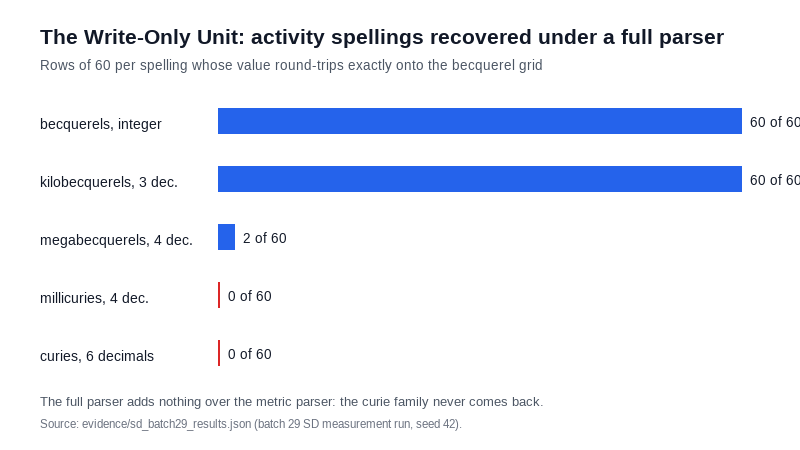
122 of 300 rows recovered — and the full parser added nothing. A register of radioactivity in becquerels was merged against copies in five spellings. The becquerel and kilobecquerel blocks recovered completely. The megabecquerel block recovered 2 of 60. The millicurie block recovered zero, and the curie block recovered zero: sixty activities written in curies at six decimal places, and not one of them converts back onto its own row. The curie is 37 billion becquerels; a millionth of a curie — the last of those six decimals — is still 37,000 becquerels. The unit can be written from any value in the register. It cannot be read back to any of them. It is, for this register, write-only.
What The Write-Only Unit means
The Write-Only Unit is the condition in which a unit is so much larger than a register's grid that every spelling in it fails to round-trip, so the unit functions as an output format only — values can be expressed in it for display, but a register stored in it has lost the values it displays. In this measurement the register held 300 activities from 100 to 1,000,000,000 becquerels on an integer grid (checksum of values 155,107,097,576). Its kilobecquerel copies at three decimals step by exactly 1 becquerel and recover 60 of 60; its megabecquerel copies at four decimals step by 100 and recover 2; its millicurie copies at four decimals step by 3,700 and recover 0; its curie copies at six decimals step by 37,000 and recover 0 (Source: evidence/sd_batch29_results.json, group AN38).
The nearest prior concept is The Silent Unit, which named spellings whose unit could not be identified from the string at all, so the parser could not tell what it was holding. The Write-Only Unit fails in the opposite way. Nothing here is ambiguous: "0.008711 Ci" announces its unit plainly, converts by an exact defined factor — one curie is exactly 3.7 × 10^10 becquerels — and still cannot return to its row, because the information the grid keeps was never in the spelling. Silence is a labelling failure; write-only is a resolution failure, and no amount of labelling repairs it.
Pitfall 1: writing activities in curies because the literature does
The first pitfall, in the order a beginner meets it, is reaching for the curie because the field's older literature is written in it. The beginner writes the register's example activity, 322,321,651 Bq, as "0.008711 Ci" — six decimals, looks precise — and has in fact recorded "somewhere between 322,288,500 and 322,325,500 becquerels", a 37,000-wide interval. The value is gone at the moment of writing, not at the moment of parsing. Correct practice: choose the storage unit from the grid, not from the literature. A register on an integer-becquerel grid stores in becquerels or kilobecquerels, whose three-decimal step is exactly one becquerel, and lets curies appear only in generated display text that is never read back.
Pitfall 2: trusting the two rows the megabecquerel block recovered
The second pitfall is reading a small recovery as a partial success. The megabecquerel block recovered 2 of 60 — the two rows whose activities are whole hundreds of becquerels, the only values a 100-becquerel step can land on. A beginner sees 2 and thinks the block mostly works with occasional rounding. It does not work at all; it coincides twice. The register's example shows the normal case: written "322.3217 MBq", the activity converts back to 322,321,700 Bq, missing its row by 49. A spelling whose step exceeds the grid does not recover approximately — it recovers only where the data happens to be as coarse as the spelling, and a register cannot be planned around coincidences.
Pitfall 3: adding decimals to the curie until it behaves
The third pitfall is the instinct to fix the curie with decimals. Six decimals step by 37,000 becquerels. Eight decimals step by 370. Ten decimals step by 3.7. The curie does not step at or below one becquerel until eleven decimal places — "0.00871140919 Ci" — at which point the spelling has become a becquerel count divided by 37 billion, written in the least readable form available. Decimals are not a dial that fixes a unit mismatch; they are the unit mismatch, expressed slowly. Correct practice is the step test before any spelling is admitted: multiply the unit ratio by ten to the minus decimals, and if the product exceeds the grid step, the spelling is display-only regardless of how many decimals anyone proposes to carry.
Pitfall 4: filing the full parser's silence as a parser bug
The fourth pitfall arrives with the merge report: exact matching recovered 60, the metric parser 122, and the full parser — the one that knows the curie — also 122. A beginner files a bug: the curie conversion is defined, the strings are clean, why did the strongest parser add nothing? Because there was nothing to add. The metric stage's 122 are the becquerel block and the kilobecquerel block plus the megabecquerel coincidences; the curie family contributed zero rows at any stage, and a parser cannot recover information the spelling never carried. The silence is the correct answer, and the register's plan should have predicted it from the step table before a single row was merged.
| Spelling | Decimals carried | Step in becquerels | Rows recovered of 60 |
|---|---|---|---|
| becquerels | 0 (integer) | 1 (the grid) | 60 |
| kilobecquerels | 3 | 1 | 60 |
| megabecquerels | 4 | 100 | 2 |
| millicuries | 4 | 3,700 | 0 |
| curies | 6 | 37,000 | 0 |
> Source: evidence/sd_batch29_results.json (batch 29 SD measurement run, group AN38).
How this measurement was run
Three hundred activities were drawn on an integer grid between 100 and 1,000,000,000 becquerels, each written in five spellings: integer becquerels, kilobecquerels at three decimals, megabecquerels at four, millicuries at four and curies at six, using the exact definition of the curie as 3.7 × 10^10 becquerels. Three parsers ran in sequence — exact string equality, a metric-prefix pass, and a full converter covering the curie family — and recovery was counted per spelling under the full parser, with a row recovered only when its spelling converts back onto its own value exactly. No row was falsely merged at any stage. The script and the result file ship with this article, and re-running the script reproduces the result file byte for byte.
Questions on The Write-Only Unit, answered
1. Is the curie a bad unit? No — it is a unit sized for sources far stronger than this register's. A curie-scale register, activities recorded to the nearest millicurie or above, would find the becquerel the awkward one. Write-only is a relation between a unit and a grid, not a property of the unit alone.
2. Why did kilobecquerels at three decimals recover perfectly? Because the step lands exactly on the grid: a thousandth of a kilobecquerel is one becquerel. Decimal spellings of metric units recover when the prefix and the decimal count are chosen so the last digit is worth one grid step — the kilobecquerel is the curie's mirror image, a spelling designed by the same arithmetic that condemns the curie.
3. The example's millicurie spelling missed by only 149 becquerels. Is that close enough? For display, certainly; for a register, the question is not closeness but identity. 322,321,800 is a different row's address — or no row's — and a merge that accepts "close" invents the false merges this measurement was careful to record as zero.
4. What should happen to legacy curie data? Keep it, flagged as an interval. A curie spelling at six decimals certifies a 37,000-becquerel range; the honest migration stores the range, marks the row's precision as lost, and recovers the exact value only if another spelling of the same activity survives somewhere.
The red line
Never let a unit whose smallest carried step exceeds the register's grid step become a storage format, however standard it is in the field's literature: write the register in the unit the grid can hold, generate the prestigious unit at display time, and treat any historical data already stored in the coarse unit as intervals, not values.