
The 14,960-Kilometre Step: a distance register migrates to AU and parsecs, and neither unit gives a single row back
156 of 300 rows recovered — and the split is total. A register of astronomical distances in kilometres was prepared for migration to the units astrono...
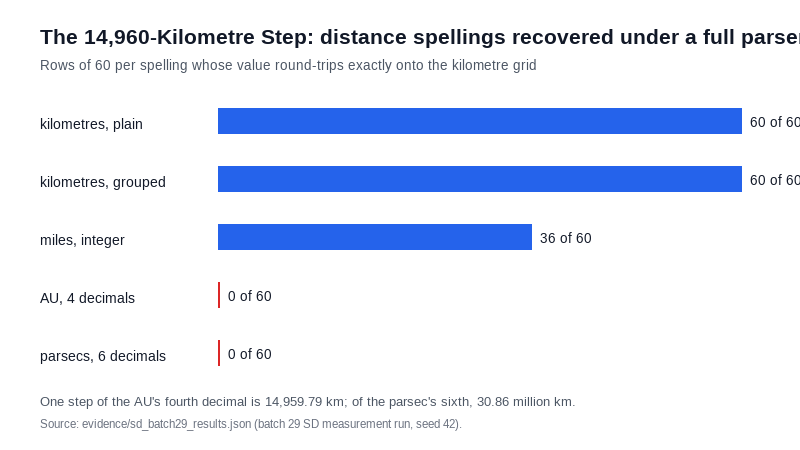
156 of 300 rows recovered — and the split is total. A register of astronomical distances in kilometres was prepared for migration to the units astronomers actually publish in, astronomical units and parsecs, and merged against copies in five spellings. The kilometre spellings, plain and thousands-grouped, recovered completely. The mile spelling recovered 36 of 60. The AU spelling, carried to four decimal places, recovered zero of 60, and the parsec spelling, at six decimals, recovered zero of 60. One step of the AU's fourth decimal is 14,959.79 kilometres; one step of the parsec's sixth decimal is 30,856,776 kilometres. The register's own grid step is one kilometre. The migration targets are not imprecise — they are fourteen thousand and thirty million times coarser than the data they were asked to hold.
What The 14,960-Kilometre Step means
The 14,960-Kilometre Step is the condition in which a unit adopted for a migration is so much larger than the register's grid that even a generously decimalled spelling of it steps by thousands of grid units, so the migrated copy cannot identify any row it was made from. In this measurement the register held 300 distances from 10,000,000 to 500,000,000,000 kilometres on an integer grid (checksum of values 73,976,540,858,805). Its AU copies at four decimals step by 14,959.79 km and recover 0 of 60; its parsec copies at six decimals step by 30,856,775.81 km and recover 0 of 60; its mile copies, integers of a far smaller unit, step by 1.609344 km and recover 36 (Source: evidence/sd_batch29_results.json, group AN36).
The nearest prior concept is The Coarser Grid, which named a register whose recording grid itself was coarser than the variation in the data, so detail was lost at the moment of writing. The 14,960-Kilometre Step is the same loss arriving by a different door: the register's grid is fine — one kilometre — and the coarseness enters only when the values are re-expressed in units sized for a different scale of problem. Nothing was wrong with the data, and nothing was wrong with the units; the failure is the ratio between them, and it is total in both directions at once, for the working unit of the solar system and the working unit of the galaxy alike.
1. The inventory before the switch: what the register holds, spelling by spelling
The pre-migration inventory counts 300 distances, each present in five spellings: kilometres plain ("324945720045 km"), kilometres grouped ("324,945,720,045 km"), integer miles, AU at four decimals, parsecs at six decimals. Two facts in the inventory predict the whole outcome. First, the register's range: the largest distance in it, 500,000,000,000 km, is 3,342.4 AU and 0.0162 parsecs — the entire register lives in the first two decimals of a parsec. Second, the step table: a spelling recovers a row only if its step is at or below the grid step of one kilometre, or lands on the grid by construction. Kilometres step by 1 by definition. Miles step by 1.609344 — near enough that 36 of 60 rows happen to sit within half a kilometre of a whole number of miles after rounding. AU step by 14,959.79. Parsecs step by 30,856,775.81. The migration was decided the moment those steps were written down; the merge only reported it.
2. The switch steps, run as planned
The switch ran in the standard order. Step one, exact matching on the strings as received: 60 rows, the plain kilometre block, since no two spellings of a value share a string. Step two, a separator-stripping pass that removes thousands grouping: 120 rows, both kilometre blocks now home. Step three, the full parser, converting miles, AU and parsecs back to kilometres and rounding to the grid: 156 rows. The mile block contributed 36; the AU and parsec blocks contributed none, and — worth recording — the full parser produced zero false merges across all 300 rows. The coarse spellings did not corrupt the register; they simply abstained from it, 120 rows of silence.
| Spelling | Decimals carried | Step in kilometres | Rows recovered of 60 |
|---|---|---|---|
| kilometres, plain | 0 (integer) | 1 | 60 |
| kilometres, grouped | 0 (integer) | 1 | 60 |
| miles | 0 (integer) | 1.609344 | 36 |
| AU | 4 | 14,959.79 | 0 |
| parsecs | 6 | 30,856,775.81 | 0 |
> Source: evidence/sd_batch29_results.json (batch 29 SD measurement run, group AN36).
3. The parallel run: the example distance in both worlds at once
The register's example value, 324,945,720,045 km, ran through both worlds. In the kilometre world it is exact in both spellings, and even its mile spelling, "201911909477 mi", converts back to the kilometre exactly — this row is one of the 36 the mile block saves. In the migration world, its AU spelling is "2172.1280 AU", and converting that back gives 324,945,723,688 km: a miss by 3,643 km, roughly the width of a continent, on a row whose own precision is one kilometre. Its parsec spelling is "0.010531 pc", which converts back to 324,952,706,107 km — a miss by 6,986,062 km. Read as a distance, the parsec copy of this row is not an approximation of the value; it is the address of a neighbourhood 7 million kilometres wide in which the value is one of thirty million integer residents, indistinguishable from its neighbours.
4. The rollback criteria, and the verdict they produce
A migration plan needs its rollback tests written before the switch, and this register's are three. Test one: the migrated spelling must recover at least the rows the old spelling recovered — failed, 0 against 60. Test two: the migrated spelling's step must not exceed the register's grid step by more than the tolerance the science allows — failed by four and seven orders of magnitude. Test three: where the target unit is kept for display, the canonical value must remain the stored one, with the display spelling regenerated on demand — this is the only form in which the migration survives. The verdict follows: roll back the AU and parsec columns as storage, keep kilometres canonical, and let AU and parsecs live where they belong, in the presentation layer, computed at print time from values that were never trusted to them. A distance register can be read in parsecs. At these magnitudes it cannot be kept in them.
How this measurement was run
Three hundred distances were drawn on an integer-kilometre grid between ten million and five hundred billion, each written in five spellings — plain and grouped kilometres, integer miles, AU at four decimals using 149,597,870.7 km per AU, parsecs at six decimals using 30,856,775,814,913.673 kilometres per parsec — and assembled into a canonical inventory and a spread inventory. Three parsers were then run in sequence: exact string equality, a pass that strips thousands separators, and a full converter that parses each unit back to kilometres and rounds to the grid. A row counts as recovered when a spelling converts back onto its own value exactly; a false merge is counted when a spelling converts onto a different row's value. The script and the result file ship with this article, and re-running the script reproduces the result file byte for byte.
Questions on The 14,960-Kilometre Step, answered
1. Would more decimals fix the AU spelling? Yes, mechanically: at seven decimals the AU step falls to about 15 km, at ten decimals to about 0.015 km, below the grid. But a distance written as "2172.1280000000 AU" has stopped being the unit astronomers publish in and become a kilometre count in costume — the decimals do the work, not the unit.
2. Why did miles, a foreign unit, beat AU so easily? Size, not familiarity. The mile is only 1.6 times the grid step, so rounding a distance to whole miles loses at most 0.8 km and 36 of 60 rows survive it. The AU is fifteen thousand times the grid step. Any unit near the grid's size behaves like the mile; any unit vastly larger behaves like the AU.
3. Is the parsec spelling ever the right storage choice? For a register whose grid is itself interstellar — distances recorded to the nearest hundredth of a parsec, say — yes. This register's largest value is 0.0162 parsecs; storing it in parsecs is storing a street address in units of continents.
4. Did any coarse row at least merge somewhere wrong? No — zero false merges in 300 rows. Coarse spellings fail silently, not corruptly: they match nothing, which is the safest failure mode and the easiest to miss in a report that only counts matches.
When to review this migration again
Re-run the step table before any future switch of storage unit, and re-check this verdict when the register's range changes: if the catalogue grows to distances where a parsec spelling at six decimals steps by less than the grid the register then keeps, the parsec column's rollback should be revisited — the verdict belongs to the ratio between unit and grid, not to the units themselves.