
The Gamma Sweep: a geophysicist's unit recovered all 60 field readings while the tesla managed six
A survey archive lands on the merge desk: three hundred magnetic field readings, recorded in milliteslas, with copies kept by the people who took them...
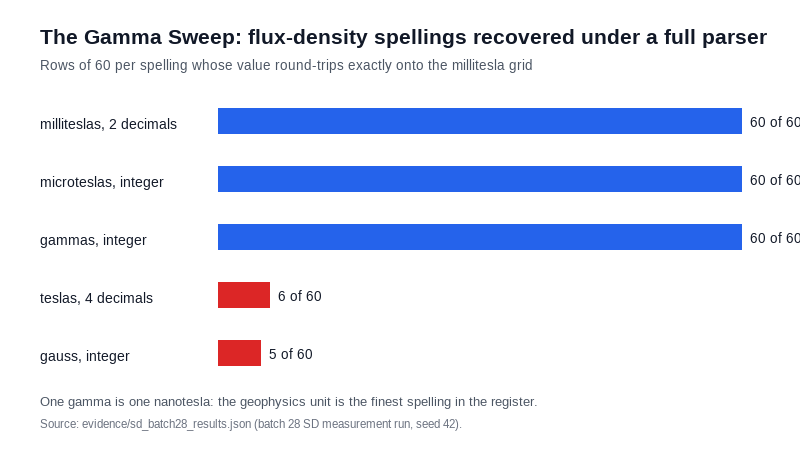
A survey archive lands on the merge desk: three hundred magnetic field readings, recorded in milliteslas, with copies kept by the people who took them — instrument exports in microteslas, a physicist's spreadsheet in teslas, a field notebook in gauss, and an old geophysics log in gammas, a unit most of the team has never seen. The merge results read like a joke at the SI's expense. The tesla block recovers 6 rows in 60. The gauss block recovers 5. The gamma block — the gamma is a nanotesla, a unit from geophysics that survives in survey archives — recovers 60 in 60, every row, exactly. The most obscure spelling in the building is the only converted one that loses nothing.
What The Gamma Sweep means
The Gamma Sweep is the condition in which the finest spelling in a register belongs to a marginal unit outside the canonical unit's prefix family, so the register's most reliable converted form is the one nobody on the team recognises. In this measurement the flux-density register's gamma copies, written as integers, step by a millionth of a millitesla — a nanotesla against a grid step of a hundredth — and recover their whole block; the tesla copies at four decimals step by 0.1 milliteslas and recover 6; the gauss integers step by the same 0.1 and recover 5. The measurement generated 300 flux densities from 0.10 to 5,000.00 milliteslas (checksum of values 778,358.32), wrote each in five spellings, and matched two inventories under three parsers, using 10 gauss per millitesla and a million gammas per millitesla (Source: evidence/sd_batch28_results.json, group AN35).
The nearest prior concept is The Finest Step, which named a flow-rate register whose recovery ranked exactly by step width — the finest converted spelling won, and the winner was an ordinary prefixed form, cubic metres per hour at three decimals. The Gamma Sweep keeps the law and changes the cast. Step width still decides everything; what is new is where the finest step lives. In the flow register the ladder's own rungs supplied the winner. Here the SI ladder's practical spellings — tesla at four decimals, gauss as integers — both step by 0.1 milliteslas and fail together, and the winning step belongs to a unit the ladder does not contain. A team that audits only the spellings it recognises will grade this register's best copy as an unknown format and its worst as the standard.
1. The case background: five copies of every reading
The case register holds 300 readings on a two-decimal millitesla grid, each surviving in five spellings: milliteslas at two decimals (the canonical form), microteslas as integers, teslas at four decimals, gauss as integers, and gammas as integers.
| Spelling | Step in milliteslas | Rows recovered of 60 (full parser) |
|---|---|---|
| milliteslas, 2 decimals | 0.01 (the grid) | 60 |
| microteslas, integer | 0.001 | 60 |
| gammas, integer | 0.000001 | 60 |
| teslas, 4 decimals | 0.1 | 6 |
| gauss, integer | 0.1 | 5 |
> Source: evidence/sd_batch28_results.json (batch 28 SD measurement run, group AN35).
The staged merge prices the archive's housekeeping. Exact string matching recovers the canonical 60. The metric stage, adding microteslas and teslas, reaches 126. The full stage, adding gauss and gammas, reaches 191, with zero false merges at every stage — the archive loses 109 readings to coarse spellings and misidentifies none. The follow-along below traces one reading through the whole case, checking each step's output as it goes.
2. Follow-along, step one: the canonical and microtesla copies
The case reading is 1,010.42 milliteslas. Step one's input is its canonical copy, "1010.42 mT". Output check: the string matches the inventory entry exactly — recovered, no arithmetic involved. The microtesla copy, "1010420 uT", divides by a thousand and returns 1,010.42 — recovered, and the check worth making is that the integer's step, a thousandth of a millitesla, is ten times finer than the grid, so this outcome is guaranteed for every row in the block, not just the case row. Both early spellings pass their checks for structural reasons: their steps are at or below the grid.
3. Follow-along, step two: the tesla and gauss copies fail together
The tesla copy reads "1.0104 T". Multiplied by a thousand it returns 1,010.40 — a miss by two hundredths, and the output check shows why: four decimals of a tesla resolve to a tenth of a millitesla, so the copy cannot express the reading's final digit. The gauss copy reads "10104 G"; divided by ten it returns the same 1,010.40, the same miss by the same two hundredths. Output check across the blocks: tesla 6 recoveries in 60, gauss 5 in 60 — the case row's failure is the blocks' typical failure, and the two spellings' identical step (0.1 milliteslas) makes them one failure with two names. A merge report that lists them separately doubles the apparent diversity of the archive's formats while halving nothing about its losses.
4. Follow-along, step three: the gamma copy closes the row
The gamma copy reads "1010420000 gamma". Divided by a million it returns exactly 1,010.42 — recovered. The output check generalises: the gamma's step is a millionth of a millitesla, a hundred thousand times finer than the grid, so the block's perfect 60 is as structural as the tesla block's failure. The row's five copies thus divide into three that carry the reading exactly (canonical, microtesla, gamma) and two that carry a rounded neighbour (tesla, gauss), and the archive's least familiar format is in the exact group. The follow-along's lesson for the desk: the copy to trust with an unverifiable row — one whose canonical form is damaged — is the gamma log, not the physicist's spreadsheet.
5. Variant applications: where else the sweep is waiting
The pattern transfers to any register whose field practitioners kept a finer unit than the office did. Survey and geophysics archives in gammas; older European field logs in gamma's sibling units; laboratory notebooks in units chosen because the instrument's dial was fine, against office systems that rounded to the respectable unit's practical decimals. In each case the audit is the same three computations: every spelling's step in canonical units, the grid step, and the ranking — and the variant to watch is the archive where the fine unit was discarded during an earlier digitisation precisely because nobody recognised it, leaving only the coarse, respectable spellings behind. This register kept its gamma log. The 109 lost rows show what the tesla and gauss copies alone would have cost; a register that threw the gamma away would report the same losses with a cleaner conscience and no way back.
Questions on The Gamma Sweep, answered
1. Is the gamma's perfection just the microtesla's, repeated? In mechanism, yes — both are integer spellings with steps far below the grid, and both recover completely. The difference is institutional: the microtesla is a rung of the canonical ladder that any audit would test, while the gamma is a foreign unit an audit might never configure. The sweep is about which spellings get tested, not about a new arithmetic.
2. Why do the tesla and gauss blocks differ at all — 6 against 5 — if their steps are identical? Identical steps give identical expectations, not identical outcomes: which rows round-trip depends on where each block's sixty values fall against the shared lattice, and one row's difference in sixty is that scatter. The blocks are one spelling for planning purposes and two lines in the report.
3. Could the tesla block be repaired with more decimals? Six decimals of a tesla step by a thousandth of a millitesla and would recover the block entire. The archive's spreadsheet was written at four — the practical precision of the unit in the wild — and the measurement grades the archive that exists.
The red line
Never discard an unrecognised unit during digitisation. An unknown spelling in an archive is an unmeasured asset: in this register the unit nobody recognised was carrying a lossless copy of all 300 readings, and the line is crossed the moment a migration deletes, truncates or "normalises" a format it has not first priced in step width — because the respectable spellings it keeps may be, as the tesla and gauss are here, the coarsest copies in the building.