
The Sixth Decimal: six decimal places of a farad still step by a whole microfarad
190 of 300 rows recovered, and the failures concentrate in the spelling that looks most precise. A capacitance register recorded in microfarads was me...
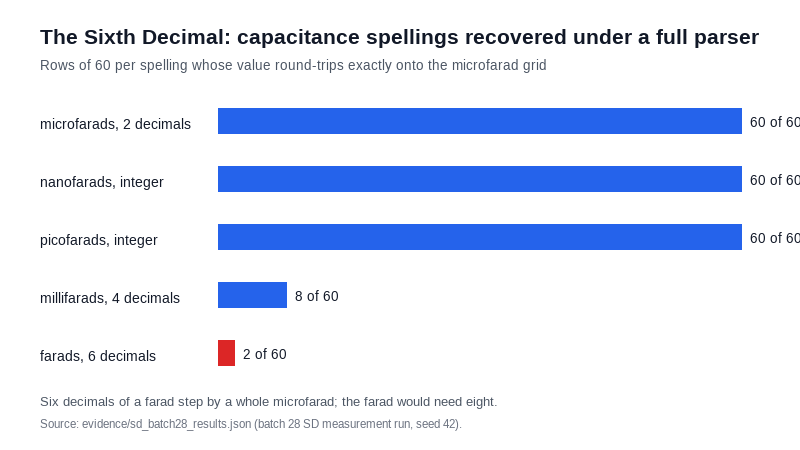
190 of 300 rows recovered, and the failures concentrate in the spelling that looks most precise. A capacitance register recorded in microfarads was merged against copies in five spellings. The integer spellings — nanofarads and picofarads, no decimals at all — recovered their blocks completely, 60 rows each. The farad spelling, written out to six decimal places, recovered 2 rows in 60: a millionth of a farad is a whole microfarad, so six decimals of the SI unit step by exactly the register's unit, a hundred grid steps at a time. The millifarad spelling at four decimals recovered 8. On this page, decimal places are not precision; they are the unit's size wearing a disguise.
What The Sixth Decimal means
The Sixth Decimal is the condition in which a spelling written in a much larger unit carries enough decimal places to look exact while its last decimal still steps by one whole unit of the register's canonical scale, so the spelling recovers only the canonical values that are whole numbers. In this measurement the capacitance register's farad copies at six decimals step by 1 microfarad against a grid step of 0.01, and recover 2 of 60; its millifarad copies at four decimals step by 0.1 microfarad and recover 8; its nanofarad and picofarad integer copies step by 0.001 and a millionth, and recover everything. The measurement generated 300 capacitances from 1.00 to 100,000.00 microfarads (checksum of values 15,481,794.55), wrote each in five spellings, and matched two inventories under three parsers (Source: evidence/sd_batch28_results.json, group AN34).
The nearest prior concept is The Five Decades, which named a resistance register spanning five orders of magnitude in which every larger-unit spelling — kilo-ohms at two and three decimals, mega-ohms at five — recovered zero rows, and the full parser added nothing at all. The Sixth Decimal is the same wall seen from one step closer. The farad spelling does not score zero; it scores 2, and the millifarad 8, because their steps (one microfarad, a tenth) sit nearer the grid than the resistance register's did. The two concepts share a law — a spelling recovers in proportion to how far below the grid its step falls — and differ in the evidence: total darkness there, a gradient here, with the gradient's ordering exactly the step table's ordering.
Pitfall 1: counting decimals instead of computing the step
The first pitfall, in the order a beginner meets it, is reading "0.064956 F" and seeing six significant decimals of precision. The correction is one multiplication: the last decimal of a farad spelling is a millionth of a farad, and a millionth of a farad is one microfarad — the register's whole unit. The spelling's resolution is one microfarad no matter how it feels to read it. Correct practice: for every spelling in a register, multiply the unit ratio by ten to the minus decimals, and write the resulting step beside the spelling before any parser is configured. A spelling whose step is not written down is a spelling whose recovery nobody has predicted, and unpredicted recoveries are how the farad block's 2-in-60 comes as a surprise instead of a plan.
Pitfall 2: assuming the integer spellings are the crude ones
The second pitfall is the mirror image: dismissing "64956420000 pF" as a crude integer form beside the farad's elegant decimals. The picofarad integer steps by a millionth of a microfarad — it is the finest spelling in the register by six orders of magnitude, and it recovers its block completely. Integers in small units are not approximations; they are exact counts. The beginner's eye ranks spellings by how scientific they look — decimals good, long integers clumsy — and the register ranks them the other way: the two integer blocks supply 120 of the 190 recoveries, the two decimal blocks supply 10 between them, and the canonical block supplies the rest.
Pitfall 3: blaming the parser for the farad block
The third pitfall appears when the merge report lands: the full parser recovered 190 rows with zero false merges, and the farad block's 58 lost rows get filed as a parser limitation, with a plan to tune tolerances.
| Spelling | Decimals carried | Step in microfarads | Rows recovered of 60 |
|---|---|---|---|
| microfarads | 2 | 0.01 (the grid) | 60 |
| nanofarads | 0 (integer) | 0.001 | 60 |
| picofarads | 0 (integer) | 0.000001 | 60 |
| millifarads | 4 | 0.1 | 8 |
| farads | 6 | 1 | 2 |
> Source: evidence/sd_batch28_results.json (batch 28 SD measurement run, group AN34).
The cause is upstream. No tolerance setting recovers a farad copy without inventing matches, because the copy genuinely does not determine the value: "0.064956 F" is the correct spelling of every capacitance from 64,955.50 to 64,956.49 microfarads, a hundred grid values wearing one string. Correct practice is to route the block to candidate generation — the farad copy nominates a hundred-row interval, other evidence picks within it — and to record the block's ceiling in the merge plan: at six decimals, the farad can confirm at most the register's whole-microfarad rows, which is what its 2 recoveries are.
The detour route: the example capacitance, taken the long way round
The register's example value, 64,956.42 microfarads, shows every pitfall in one row. The short way — read the farad copy, "0.064956 F", convert — returns 64,956.00, missing the value by 0.42 and landing on a whole number the register may or may not hold. The millifarad copy, "64.9564 mF", returns 64,956.40, missing by 0.02: nearer, and still wrong. The detour goes through the integers. The nanofarad copy, "64956420 nF", divides by a thousand and returns 64,956.42 exactly. The picofarad copy, "64956420000 pF", divides by a million and returns it again. Two ungainly integers carry the value perfectly; two graceful decimals each lose a different piece of it — the farad its hundredths entirely, the millifarad its final digit. A merge that processes spellings in the order a datasheet would print them meets the failures first and the exact forms last, and may never reach them if the early failures trigger a tolerance investigation.
Questions on The Sixth Decimal, answered
1. How many decimals would the farad spelling need? Eight. Seven decimals of a farad step by 0.1 microfarads — the millifarad's current position, worth single-digit recoveries — and eight step by 0.01, the grid itself, at which point the spelling recovers everything whose value it can express. The gap between the register's six and the needed eight is the whole finding.
2. Why did the millifarad block recover 8 rather than the expected 6? Its step is ten grid steps, so a value round-trips when it sits on the coarser lattice — roughly one row in ten, with scatter. Eight in sixty is that expectation with ordinary variance; the farad's 2 in 60, at one row in a hundred expected, is the same arithmetic at a crueller step.
3. Are the lost farad rows recoverable from anything else in the register? Each row exists in all five spellings, so a row lost in the farad block is usually recovered through its integer copies. The 110 rows the full parser lost overall are rows whose several coarse spellings all missed; the farad block's losses matter when it is a row's only surviving form, which is a statement about the archive, not the parser.
4. Does this apply beyond capacitance? To any quantity whose working unit is a millionth of its SI unit — the register's structure, not the capacitor, is the cause. Wherever the canonical scale is micro- anything, the SI spelling needs eight decimals to see the grid, and will be written with six.
When to re-check this judgment
Re-check the farad block's ceiling whenever the register's grid changes: the verdict — 2 recoveries in 60 at six decimals — is a property of the step ratio between the spelling and the grid, not of the values. If a future register records capacitances at one decimal instead of two, the same six-decimal farad steps by ten grid steps and its recovery rises toward the millifarad's; if the grid tightens to three decimals, even the millifarad joins the farad in single digits. The judgment to re-run is always the same division: spelling step over grid step, per block, before the merge.