
The One-Lux Step: two illuminance spellings step by a whole lux, and recover nothing at all
0 and 0: those are the recovery counts of the two larger-unit spellings in this illuminance register. Three hundred light levels, recorded in lux on a...
0 and 0: those are the recovery counts of the two larger-unit spellings in this illuminance register. Three hundred light levels, recorded in lux on a two-decimal grid, were copied into kilolux at three decimals and into phots at four decimals — and not one of the 120 copies round-trips. Both spellings step by exactly one lux: a thousandth of a kilolux is a lux, a ten-thousandth of a phot is a lux. A register whose values live between the whole lux — hundredths of a lux, recorded faithfully across five orders of magnitude — is invisible to a spelling that can only land on whole numbers. The copies are not wrong, exactly. They are a lux too coarse to see the register at all.
What The One-Lux Step means
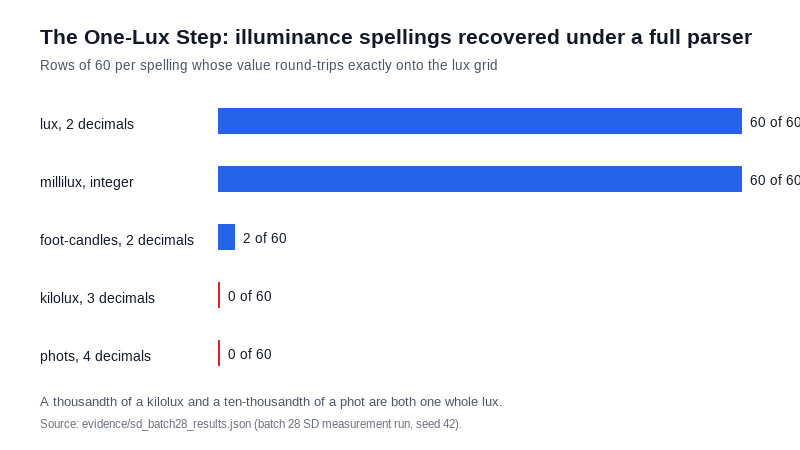
The One-Lux Step is the condition in which a converted spelling's step width equals the canonical unit itself — one whole unit of the quantity being measured — so the spelling can represent only the register's whole-number values and recovers none of a register recorded at finer precision. In this measurement the illuminance register's kilolux copies (three decimals) and phot copies (four decimals) both step by 1 lux against a grid step of 0.01 lux, and recover 0 rows of 60 each; the foot-candle copies, stepping by 0.107639 lux, recover 2; the millilux integer copies, stepping by 0.001 lux, recover all 60. The measurement generated 300 illuminances from 1.00 to 100,000.00 lux (checksum of values 14,174,135.75), wrote each in five spellings, and matched two inventories under three parsers, using 10.7639104 lux per foot-candle (Source: evidence/sd_batch28_results.json, group AN33).
The nearest prior concept is The Thousand Step, which named a density register whose gram-per-cubic-centimetre and kilogram-per-litre spellings stepped by 10 kg/m3 — a thousand grid steps — and recovered 3 and 8 rows in sixty: a spelling could be a thousand times too coarse and still catch the values that happened to sit on its lattice. The One-Lux Step is the limiting case the density register approached but never reached. Here the coarse spellings catch nothing, because a one-lux lattice over a five-decade register of two-decimal values intersects the register only at its whole-number rows, and this register — 300 values drawn across 1 to 100,000 — holds almost none. A thousand steps too coarse is a sieve. One whole unit too coarse is a wall.
1. The resource list: five spellings, categorised by what they can see
The resources available to anyone merging this register, in categories. Exact resources: the canonical lux spelling itself (60 of 60 by string) and the millilux integer spelling (60 of 60 by conversion) — the two forms whose steps are at or below the grid. Approximate resources: the foot-candle spelling, the only converted form that recovers anything at all, 2 rows in 60 — useful as a candidate generator, useless as a matcher. Decorative resources: the kilolux and phot spellings, which between them contribute zero recoveries and serve only to make the inventory look multilingual. The categorisation is the deliverable: a merge plan that lists five spellings as five resources has miscounted; it has two resources, one candidate generator, and two decorations.
2. Essential and optional tiers: where the merge's weight actually rests
Essential tier: the canonical and millilux forms. Between them they carry the entire successful merge — the staged parsers stand at 120 matched after the metric stage, which is exactly these two blocks, and the full parser adds only the foot-candle's 2. Optional tier: the foot-candle form, worth running because its failures are silent losses rather than false merges — this group records zero false merges at every stage — so its 2 recoveries are free. Below the line: the kilolux and phot forms, which a merge may process for completeness but must never wait for. The tiering inverts the units' prestige: the phot, a named unit of a classical system, is decorative; the millilux, a prefixed form nobody specifies, is load-bearing.
3. Priority order: a 31,028.15 lux reading, chased through the list
Work the register's example value, 31,028.15 lux, down the priority order. First resource, the canonical spelling: "31028.15 lux" matches exactly. Second, the millilux copy: "31028150 mlux" converts back to exactly 31,028.15 and recovers. Third, the foot-candle copy: "2882.61 fc" converts to 31,028.16 — a miss by one hundredth of a lux, close enough to nominate the row, too far to confirm it. Fourth and fifth, the decorative pair: "31.028 klux" returns 31,028.00 and "3.1028 phot" returns 31,028.00 — the two spellings agree with each other on a value the register does not hold at this row, a whole-lux landing fifteen hundredths below the truth. The priority order is not a preference; it is the order in which the forms stop being able to see the value at all.
| Spelling | Step in lux | Rows recovered of 60 | Tier |
|---|---|---|---|
| lux, 2 decimals | 0.01 (the grid) | 60 | essential |
| millilux, integer | 0.001 | 60 | essential |
| foot-candles, 2 decimals | 0.107639 | 2 | optional |
| kilolux, 3 decimals | 1 | 0 | decorative |
| phots, 4 decimals | 1 | 0 | decorative |
> Source: evidence/sd_batch28_results.json (batch 28 SD measurement run, group AN33).
4. Substitute resources: what to do when only a coarse spelling survives
Some rows of a real register will survive only in a coarse spelling, and the substitutes are these. Substitute one: range matching — treat a kilolux copy as an interval of one lux and match it against every canonical row inside the interval, flagged as ambiguous; over this register's density that is usually one row, but the flag must say the match was made by containment, not by value. Substitute two: a second coarse spelling of the same row — where a row survives in both kilolux and phot, the two intervals coincide (both step by one lux), which narrows nothing but at least confirms the whole-lux neighbourhood from two independent roundings. Substitute three, the honest one: leave the row unmatched and record it as held in a named coarse spelling, so the register's coverage report distinguishes "lost" from "held at one-lux resolution" — different problems with different remedies.
Questions on The One-Lux Step, answered
1. Why exactly zero, rather than a few lucky rows? A coarse spelling recovers a row only when the value is a whole number of lux. This register's 300 values are drawn on a two-decimal grid across five decades, so whole-lux values are rare — and in the two coarse blocks, the rows they were given happened to contain none that survived rounding onto the lattice. Zero is the expected outcome made visible, not an anomaly.
2. The phot has four decimals and the kilolux three — why do they tie? Because decimals are counted in the spelling's own unit. Four decimals of a phot (a ten-thousand-lux unit) and three decimals of a kilolux (a thousand-lux unit) both resolve to one lux. The decimal count is a property of the notation; the step is a property of the arithmetic, and only the step merges.
3. Does the foot-candle's near-miss on the example row count for anything? As a nomination, yes: a candidate generator that lands within a hundredth of a lux has found the row's neighbourhood. As a match, no — and the group's zero false merges exist precisely because the parser refused to promote near-misses.
The next action
Compute the step width of every spelling in the register before the next merge runs, and strike from the matcher any spelling whose step equals or exceeds one whole canonical unit: in this register that single act removes two of five blocks from the pipeline, changes the recovery total by zero rows, and converts the coverage report from a list of spellings into a true statement about which forms of the data can still see it.