
The Exact Guest: why did the gravitational unit round-trip all 60 forces while the SI kilo- spelling managed one?
Why would a force register trust its kilogram-force copies more than its kilonewton ones? The measurement says it should. Three hundred forces, record...
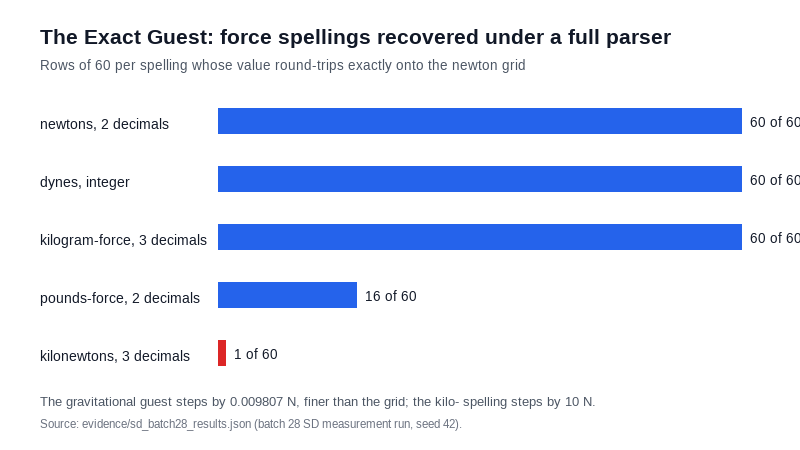
Why would a force register trust its kilogram-force copies more than its kilonewton ones? The measurement says it should. Three hundred forces, recorded in newtons, were merged against copies in five spellings. The kilonewton block — the canonical unit with an SI prefix, the spelling any style guide would recommend — recovered 1 row in 60. The kilogram-force block, a gravitational unit that has no place in the SI at all, recovered 60 in 60: every single row round-tripped exactly. The dyn block, another outsider, also recovered all 60. The guest units were exact; the house unit's own family was the failure.
What The Exact Guest means
The Exact Guest is the condition in which a non-system unit, present in a register as a legacy or trade spelling, converts back to the canonical unit losslessly across an entire block, while a spelling from the canonical unit's own prefix family loses nearly every row. In this measurement the force register's kilogram-force copies, written at three decimals, step by 0.009807 newtons — just under the register's two-decimal grid step of 0.01 — so every value survives the round trip; its kilonewton copies, written at three decimals, step by 10 newtons, a thousand grid steps, and one row in sixty survives. The measurement generated 300 forces from 1.00 to 50,000.00 newtons (checksum of values 8,177,324.62), wrote each in five spellings, and matched two inventories under three parsers, using 4.4482216152605 newtons per pound-force and 9.80665 newtons per kilogram-force (Source: evidence/sd_batch28_results.json, group AN32).
The nearest prior concept is The Borrowed Gravity, which named torque values written in kilogram-force metres, where the gravitational unit enters a register borrowed from the mass column's world. The Exact Guest is what the borrowed unit does when it is given enough decimals: it stops behaving like a borrowing and starts behaving like the most precise spelling in the building. The Borrowed Gravity was about provenance — whose unit this is. The Exact Guest is about performance — the borrowed unit, at three decimals, is finer than the grid it has to land on, while the legitimate kilo- spelling at the same three decimals is a thousand times too coarse. Provenance and precision are different audits, and this register passes the guest on the second while failing the heir on it.
Step 1: state the goal and the pass criteria
Goal: merge the spread copies of the force register back into the canonical newton inventory without losing rows and without inventing any. Pass criteria, set before any parser runs: the merge is acceptable only if every spelling block's recovery is reported separately, the false-merge count is zero, and any block recovering under half its rows is quarantined as candidates rather than confirmed matches. A parser stage that cannot meet the criteria for a block does not get to process that block.
Step 2: run the exact stage and record the baseline
Exact string matching recovers the canonical block, 60 of 300, with zero false merges. This is the baseline every later stage is priced against: any conversion stage must justify itself in rows gained over 60, at a cost of zero invented matches. Pass criterion for proceeding: the baseline report names the five blocks and their sizes, so later gains can be attributed to spellings rather than to the parser in general.
Step 3: add the metric stage and watch it stall
The metric stage adds the kilonewton block — and stalls: 61 matched, one row gained, zero false merges. The stall is the diagnostic. A parser that understands the canonical unit's own prefix and gains a single row is telling the operator that the spelling, not the parser, is the constraint: three decimals of a kilonewton cannot express a two-decimal newton value except when the value happens to be a whole multiple of ten. Pass criterion for this step: if a stage gains fewer than one row in twenty, stop and measure the spelling's step width before adding any more rules — the step table, not the code, is where the loss lives.
Step 4: apply the full parser and read the result table
| Spelling | Step in newtons | Rows recovered of 60 | False merges |
|---|---|---|---|
| newtons, 2 decimals | 0.01 (the grid) | 60 | 0 |
| dynes, integer | 0.00001 | 60 | 0 |
| kilogram-force, 3 decimals | 0.009807 | 60 | 0 |
| pounds-force, 2 decimals | 0.044482 | 16 | 0 |
| kilonewtons, 3 decimals | 10 | 1 | 0 |
> Source: evidence/sd_batch28_results.json (batch 28 SD measurement run, group AN32).
The full parser reaches 197 matched with zero false merges — the cleanest failure profile in the batch: nothing is misidentified, and 103 rows are simply lost, almost all of them to the kilonewton and pound-force blocks. The table's order is the lesson. Recovery follows the step column exactly, and the step column does not care that the kilogram-force is a gravitational unit defined by a mass under standard gravity, nor that the dyne belongs to a superseded system. The two finest spellings after the canonical are both guests, and both are perfect.
Step 5: work one force through all five spellings
The example force, 36,211.11 newtons, separates the spellings by hand. As "36211.11 N" it matches exactly. As "3621111000 dyn" it returns 36,211.11 and recovers. As "3692.506 kgf" it returns — through multiplication by 9.80665 — exactly 36,211.11, and recovers: the guest is exact even on a five-digit force with two decimals to preserve. As "8140.58 lbf" it returns 36,211.10, missing by a single hundredth, the cruellest landing in the block. As "36.211 kN" it returns 36,211.00, missing by eleven hundredths — the house spelling is not even close. A buyer of parsers who tested only the kilonewton block would conclude the register is unmergeable; the register was fine, and so were two of its guests.
Step 6: the completion check
The merge is complete when the report can state, per spelling: rows in, rows recovered, false merges, and the step width that explains the recovery. For this register: 300 in, 197 recovered, 0 invented, and a step table in which every block's fate is visible before the fact. The check fails any report that aggregates the guest blocks into a single "imperial conversions" line — the aggregate would hide the register's most useful fact, which is that its kilogram-force copies are a lossless backup of the whole inventory and its kilonewton copies are nearly worthless.
Questions on The Exact Guest, answered
1. Is the kilogram-force's perfect score a fluke of this register? No. Its step, 0.009807 newtons, is finer than the register's grid step of 0.01, so every grid value has a kilogram-force spelling at three decimals that returns it exactly. The perfection is arithmetic, not luck, and it would hold for any register on this grid.
2. Why does the pound-force block land in the middle? Its step, 0.044482 newtons, is about four and a half grid steps: fine enough to recover the values that happen to sit near its lattice points (16 of 60), too coarse for the rest. It is the only block whose recovery is a matter of chance rather than of structure.
3. Could the kilonewton block be fixed with more decimals? Yes — six decimals of a kilonewton step by 0.01 newtons, the grid itself. But the register as it exists in the wild is written at three, and the measurement grades the register that exists, not the one that should.
4. Should the guest units be converted and deleted? Converted, yes; deleted, no. The kilogram-force and dyne blocks are the register's only lossless duplicates. Deleting them after conversion would destroy the backup that made the merge verifiable.
The conclusion, in one sentence
In a force register, trust is earned by step width and not by pedigree — the gravitational guest at three decimals is a lossless copy of all 300 rows while the canonical unit's own kilo- spelling preserves one row in sixty — applicable to any register where a legacy unit was written with more decimals than the house style gave its own prefixes.