
The Relabelled Row: a sound register recovered 120 rows by changing their labels, and invented 27 matches doing it
The strongest-looking result in this measurement is the one that did the least work. A register of 300 sound levels, written in decibels, was merged a...
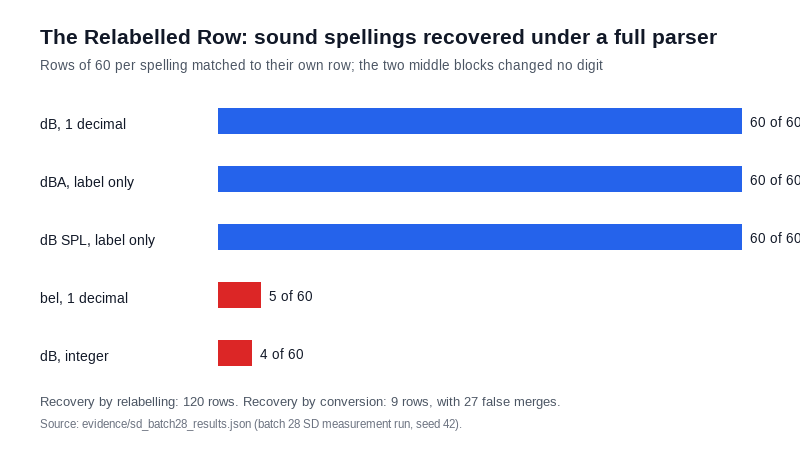
The strongest-looking result in this measurement is the one that did the least work. A register of 300 sound levels, written in decibels, was merged against copies of itself in five spellings. The parser stage that understands labels — accepting "dBA" and "dB SPL" as spellings of the canonical "dB" — jumped the match count from 60 to 184, recovering two entire blocks of 60 without converting a single digit, because the copies carry the same digits under different labels. The stage that then added real conversions, integer decibels and bels, gained only five more rows and produced 27 false merges: matches to the wrong row. The register's recovery was bought by relabelling; its errors were bought by arithmetic.
What The Relabelled Row means
The Relabelled Row is the condition in which a merge recovers a record by accepting a different unit label over unchanged digits, so the match is exact as a string operation and unverified as a measurement: the row is recovered because the parser decided the labels mean the same thing, not because any value was converted. In this measurement the two relabelled spellings — the register's values written as "44.6 dBA" and "44.6 dB SPL" against a canonical "44.6 dB" — supplied 120 of the 189 total matches under the full parser. The measurement generated 300 sound levels from 20.0 to 120.0 dB on a one-decimal grid (checksum of values 21,230.1), wrote each in five spellings, and matched two inventories under three parsers, converting bels at 10 dB per bel (Source: evidence/sd_batch28_results.json, group AN30).
The nearest prior concept is The Assumed Equal, which named a concentration register in which ppm — defined as mg/L's equal — recovered one row in sixty at integer precision, the assumed equality failing on the rounding. The Relabelled Row is the assumed equality succeeding on the scoreboard. Where ppm's equality was arithmetically testable and failed, the dBA label's equality is not arithmetically testable at all inside the merge: the digits agree perfectly, the match is counted, and whether an A-weighted level and an unweighted level should ever be the same row is a question the parser has answered by fiat. One concept is an equality that rounding exposes. The other is an equality that nothing in the pipeline can expose, because it never touches a number.
1. Stop the bleeding: freeze the bel and integer blocks first
The immediate action in a merge showing this signature — a large recovery jump at a label stage, false merges at a conversion stage — is to freeze the two converting spellings. In this register those are the integer-decibel block and the bel block. Between them they recover 9 rows of 120 under the full parser (4 and 5 respectively) while their rounding manufactures the false merges: an integer decibel steps by a whole decibel, ten grid steps, and a bel at one decimal steps by the same whole decibel, so both spellings park their rounded outputs on other rows' values. The example row shows the mechanism in miniature. The value 44.6 dB written as "45 dB" returns 45.0; written as "4.5 B" it also returns 45.0. Two different spellings, one wrong landing — and if the register holds a genuine 45.0, both copies testify for it.
2. The temporary workaround: report the label matches as a separate class
Until the label question is settled, the merge report should carry three numbers, not one: 60 rows matched exactly, 120 rows matched by relabelling, and the converting blocks quarantined. The workaround is honest because it prices the label stage's contribution correctly — the 120 rows are found, and they are probably the right rows in a register whose copies were made by relabelling, as this measurement's copies were. What the workaround refuses to do is let the 120 inflate the pipeline's conversion record. A merge that reports "189 of 300 recovered" has hidden the fact that its converter, the part that handles genuinely different spellings, recovered 9 rows and invented 27 matches.
| Spelling | Digits changed? | Rows recovered of 60 | False-merge risk |
|---|---|---|---|
| dB, 1 decimal | canonical | 60 | none |
| dBA, 1 decimal | no — label only | 60 | the label itself |
| dB SPL, 1 decimal | no — label only | 60 | the label itself |
| dB, integer | rounded | 4 | steps of 1 dB |
| bel, 1 decimal | converted and rounded | 5 | steps of 1 dB |
> Source: evidence/sd_batch28_results.json (batch 28 SD measurement run, group AN30).
3. The root-cause fix: make the label a column, not a conversion
The root cause is that the register stored a measurement and its weighting in one string, so a later merge had to guess whether the label was decoration or information. The fix has three steps. Step one: split every sound-level field into a numeric value and a label field at ingestion, so "dBA" is preserved as data rather than parsed as noise. Step two: merge on the numeric value only within a label class — dB rows merge with dB rows, dBA with dBA — and let cross-label matches be proposed, never confirmed, by the pipeline. Step three: where a cross-label identity is genuinely wanted, record it as an explicit mapping decision with an owner, so the 120 recoveries become a stated policy instead of a parser side-effect. Under that regime this register merges cleanly: the canonical block matches exactly, each relabelled block matches within its class, and the bel and integer blocks go through the converting parser with their false merges visible and attributable.
4. Verification and closure: what a clean report looks like
Closure requires the merge report to show its work by spelling. Verified against this measurement: exact stage 60 matched, 0 false; label stage 184 matched, 11 false — note that even the label stage's false merges are traceable: the integer block's rounded strings parse to whole-decibel floats that coincide with other rows' canonical values, so collisions appear before any unit conversion is switched on; full stage 189 matched, 27 false. A report that reproduces those six numbers, by stage, with the label matches broken out as their own class, is a closed report. A report that shows only the final 189 is the failure this article is about, still in progress.
Questions on The Relabelled Row, answered
1. Are the dBA matches actually wrong? In this measurement, no — the copies were constructed with identical digits, so the rows are the right rows. The point is that the parser cannot know that: it recovered them by deciding a label question, and in a register where the dBA copies had been measured independently, the same code would recover different rows with the same confidence.
2. Why did the label stage already have 11 false merges? The label parser already converts the integer block by accident: an integer string like "45 dB" parses to the float 45.0, which is another row's canonical value whenever the register holds a whole-decibel row. So the integer copies begin colliding as soon as any parsing is switched on. The bel conversion then multiplies the effect — 27 false merges at the full stage — it does not create it.
3. Why do the integer and bel blocks recover so few rows? Both step by 1 dB, ten times the grid step of 0.1 dB. A spelling recovers a row only when the value happens to sit on its coarser lattice — whole decibels — which is 4 and 5 rows in sixty here.
4. Should the bel block be converted at all? Yes, with its output quarantined as candidates. The bel conversion is legitimate arithmetic; what it cannot survive is rounding to one decimal before conversion. The fix is to carry more decimals through the conversion, not to ban the unit.
The decision rule
Count label matches and conversion matches in separate columns, always: a merge may report a row as recovered by relabelling or recovered by conversion, never as an undifferentiated recovery, and any pipeline whose label matches outnumber its conversion matches — here 120 to 9 — is a labelling exercise with a converter attached, and must be governed as one.