
The Assumed Equal: which concentration spelling should a lab standardise on, when ppm is defined as mg/L's equal and recovers 1 row in 60?
Which written form should a water-quality laboratory standardise on for concentrations it records in milligrams per litre? The obvious candidate is pa...
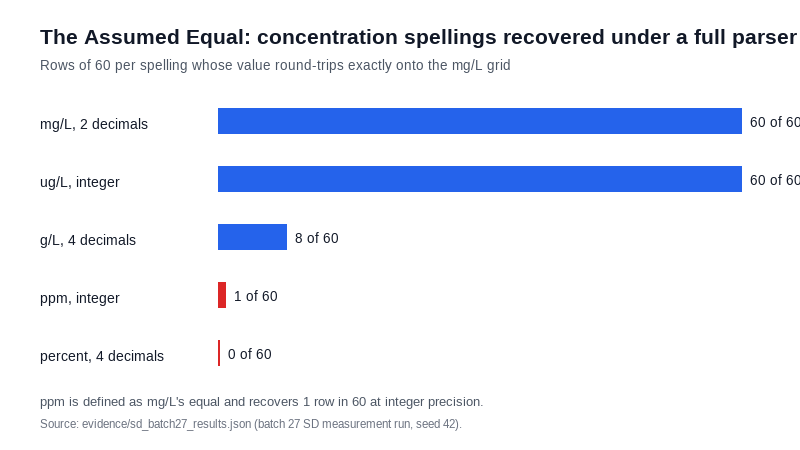
Which written form should a water-quality laboratory standardise on for concentrations it records in milligrams per litre? The obvious candidate is parts per million, because for dilute water samples ppm and mg/L are treated as the same number — the conversion factor is one. The measurement says the obvious candidate is nearly the worst choice available. Three hundred concentrations on a two-decimal mg/L grid were written in five spellings and parsed back: integer ppm recovers 1 of its 60 rows. The spelling that recovers everything besides the canonical form is the one that looks most unwieldy, micrograms per litre as integers, with strings up to nine digits. This article runs the selection properly: requirements first, the five candidate spellings compared on the evidence, a decision rule, and the first step.
What The Assumed Equal means
The Assumed Equal is the condition in which a unit that is definitionally equal to the canonical unit — equal by a factor of exactly one, as ppm is to mg/L for dilute aqueous samples — is written at a precision that destroys the equality in practice, so the equal unit recovers almost nothing while genuinely converted units recover everything. A concentration exhibits it when its ppm spelling, an integer, steps by 1 mg/L across a grid of 0.01, so only the rare whole-number concentration survives the round trip. The measurement behind this article generated 300 concentrations from 10.00 to 50,000.00 mg/L (checksum of values 7,719,948.29), wrote each in five spellings, and matched two inventories under three parsers, taking 1 ppm = 1 mg/L, 1 percent = 10,000 mg/L and exact powers of a thousand for the gram and microgram forms (Source: evidence/sd_batch27_results.json, group AN29).
The nearest prior concept is The Unit Mirage, which described values whose units were present but spelled in competing suffixes, so the digits survived an import while the meaning attached to them did not. The Assumed Equal is the quieter failure. Every spelling here carries its unit openly, and the parser reads each one correctly; nothing is disguised. The loss happens inside a single, honestly labelled unit, at the moment a value is rounded to the integer that the unit's everyday usage demands. The Unit Mirage is about units deceiving the reader. The Assumed Equal is about a true fact — ppm equals mg/L — licensing a spelling whose precision the equality cannot survive.
1. The requirements: what a standard spelling must do
Four requirements govern the choice. First, exact round-trip: a value written in the standard spelling and parsed back must return the recorded value, for every row, not most rows. Second, unambiguous parsing: the string must carry its unit in a form no other candidate uses, so a merged file can be read without knowing which block a row came from. Third, human legibility: technicians must be able to read and transcribe the strings without error, which counts against extreme lengths. Fourth, step transparency: the spelling's step in mg/L must be computable from the string's form alone, so future readers can audit it. The canonical mg/L at two decimals meets all four by definition and is the incumbent; the question is which spelling a lab should accept from instruments and suppliers whose native output is something else.
2. The candidates compared: five spellings against the requirements
| Candidate spelling | Step in mg/L | Rows recovered of 60 | Exact round-trip? |
|---|---|---|---|
| mg/L, 2 decimals | 0.01 | 60 | yes (canonical) |
| ug/L, integer | 0.001 | 60 | yes |
| g/L, 4 decimals | 10 | 8 | no |
| ppm, integer | 1 | 1 | no |
| %, 4 decimals | 100 | 0 | no |
> Source: evidence/sd_batch27_results.json (batch 27 SD measurement run, group AN29). Full-parse totals across all five blocks: 129 of 300, zero false merges.
The comparison eliminates three candidates on the first requirement alone. Percent at four decimals steps by 100 mg/L and recovers nothing; it is a reporting format for strong solutions, not a register spelling. Grams per litre at four decimals steps by 10 and recovers 8. Integer ppm steps by 1 — a hundred grid steps — and recovers the single row in its block whose concentration is a whole number, which is the entire practical content of the famous equality: ppm and mg/L are interchangeable exactly when the value has no decimals worth keeping. The microgram spelling is the surprise winner on evidence: as an integer count it steps by 0.001 mg/L, ten times finer than the grid, and recovers all 60 rows, at the cost of strings like "43899230 ug/L". It fails the legibility requirement in spirit while passing every numerical one, which is the genuine trade the selection has to price.
3. The selection decision rule, and the worked example behind it
The rule the evidence supports: accept a non-canonical spelling as a register input only if its step is at or below the grid, and convert it to canonical mg/L at the boundary, storing the original string beside the value. Under that rule, ug/L integers are accepted, everything else in this set is re-requested or stored as an approximation with its step recorded. The run's example concentration, 43,899.23 mg/L, shows what the rule is deciding between. As "43899230 ug/L" it returns 43,899.23 exactly. As "43.8992 g/L" it returns 43,899.20. As "43899 ppm" it returns 43,899.00 — the assumed equal, off by 0.23 — and as "4.3899 %" it also returns 43,899.00, so the two coarsest spellings agree with each other at a value that is not the concentration, while the nine-digit string nobody wanted to read is the only converted form that has it right.
4. The first step to start: re-issue the standing instruction to suppliers
The first step is documentary, not technical: amend the laboratory's standing instruction to instrument vendors and contract suppliers so that concentration data is requested in mg/L at two decimals or ug/L as integers, and ppm figures are accepted only with a note that they carry a 1 mg/L step. Existing ppm-sourced rows in the register should be flagged with that step rather than silently carried as exact values, because a result reported against a regulatory limit can sit within 1 mg/L of the limit on the strength of a rounding nobody recorded. That single amendment, applied at the boundary where data enters, prevents the next register from inheriting the assumption this measurement priced.
Questions on The Assumed Equal, answered
1. Is ppm really equal to mg/L? For dilute aqueous samples, yes, to the precision this measurement assumes: one litre of such a sample has a mass of about one kilogram, so one milligram per litre is one part per million by mass. The equality is definitional here — and the integer spelling of it still loses 59 of 60 values, which is the article's point: equality of units is not equality of spellings.
2. Why does the percent spelling recover nothing at all? Four decimals of a percent step by 100 mg/L, ten thousand grid steps. A concentration would have to be a whole multiple of 100 mg/L to survive, and none of the block's 60 values is.
3. Are the long ug/L strings practical? Numerically they are perfect and humanly they are hostile: nine-digit strings invite transcription slips that a parser cannot detect. The decision rule accepts them as machine-supplied input, converted at the boundary — not as a form humans should type.
4. What should be done with historical ppm data? Keep it, flagged. An integer ppm figure is a measurement to within 1 mg/L, which is adequate for many purposes; the failure is treating it as exact. The flag, not the figure, is what is missing.
The next action
Adopt the step rule at the data boundary this week: mg/L at two decimals or ug/L integers in, everything else converted with its step recorded or re-requested, and the register's existing ppm-sourced rows flagged at a 1 mg/L step. The next action is deliberately small — one instruction amended, one flag added — because the measurement shows the defect enters at the boundary, and a boundary rule is the whole fix.