
The Five Decades: adding a kilo-ohm parser to the merge added exactly zero rows
The strongest parser in this measurement is no stronger than the middle one. A resistance register spanning 1 to 100,000 ohms was merged in three stag...
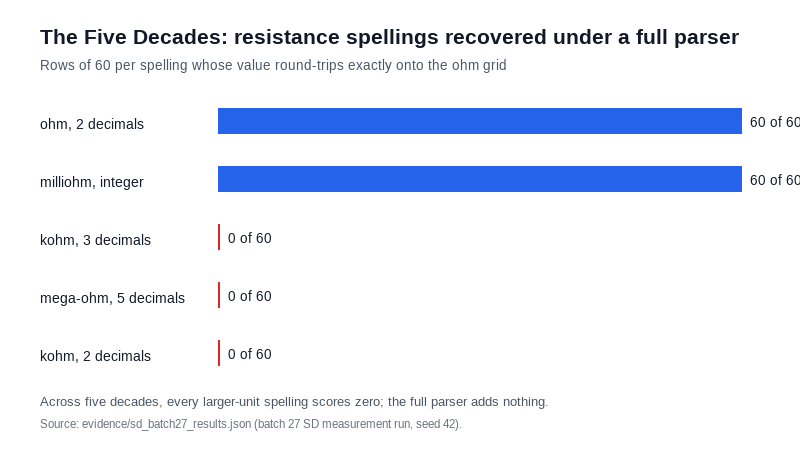
The strongest parser in this measurement is no stronger than the middle one. A resistance register spanning 1 to 100,000 ohms was merged in three stages: exact matching found 60 rows, a parser for the plain spellings — ohms, milliohms as integers, mega-ohms — found 120, and the full parser, which adds both kilo-ohm spellings, found 120 again. Not one of the 120 kilo-ohm rows in the file matches anything, at either of the two precisions the sources print, three decimals or two. The mega-ohm block scores zero as well. Across an inventory that spans five decades, every spelling written in a unit larger than the ohm is a total loss, and the two kilo-ohm precisions, whose steps differ by a factor of ten, tie at nothing.
What The Five Decades means
The Five Decades is the condition in which an inventory's values span so many orders of magnitude that every larger-unit spelling, at the precisions sources print, steps over the entire recording grid for effectively every row — so recovery in the larger units is not low but zero, and differences in their precision stop mattering. A resistance exhibits it when its kilo-ohm spellings at three and two decimals both return values a whole number of tens or hundreds of ohms away from the recorded one: three decimals of a kilo-ohm steps by 10 ohms and two decimals by 100 ohms, against a grid of 0.01 ohm, across values that run from 1.00 to 100,000.00 ohms. The measurement behind this article generated 300 such resistances (checksum of values 15,293,038.00), wrote each in five spellings, and matched two inventories under three parsers (Source: evidence/sd_batch27_results.json, group AN28).
The nearest prior concept is The Coarse Tonne, which named one coarse spelling — tonnes at four decimals, stepping ten times wider than its grid — recovering a handful of rows while the finer spellings around it recovered everything. The Five Decades is that failure with the volume turned up and the company removed. The Coarse Tonne's coarse spelling still caught the values that happened to land on its lattice, 7 of 60. Here three separate larger-unit spellings catch none of 180 rows between them, because the inventory's five-decade spread means a step of 10 ohms is not a lattice some values land on; it is a sieve with holes wider than the local density of values almost everywhere. Precision differences inside the failing family also vanish: ten times the decimals buys the same zero.
1. The case: one register, five decades, five spellings
The case followed here is a component register of 300 resistances, recorded in ohms to two decimals, values drawn from 1.00 to 100,000.00 ohms — five decades, from a one-ohm shunt to a hundred-kilo-ohm bias resistor, in one column. The second inventory writes the same components as sources write them: ohms at two decimals; milliohms as integers; kilo-ohms at three decimals, the datasheet habit; mega-ohms at five decimals; and kilo-ohms at two decimals, the catalogue habit. The merge is followed stage by stage below, and each stage's output is checked against what the stage was supposed to add. The register's breadth is the case's defining fact: a range this wide is normal for components, and it is exactly the range over which fixed-decimal larger-unit spellings cannot survive.
2. Follow-along, stage one: exact matching, and its output check
Stage one matches strings. Output: 60 of 300, the canonical ohm block, zero false merges. Output check: the stage recovered exactly the block it should — every row already written as the register writes it — and the check passes. The remaining 240 rows are present in both files and invisible to this stage, which is expected behaviour and not yet a finding.
3. Follow-along, stage two: the plain SI parser, and its output check
Stage two adds a parser for the plain spellings: ohms, integer milliohms and mega-ohms. Output: 120 of 300. The milliohm block contributes all 60 of its rows — an integer count of milliohms steps by 0.001 ohm, ten times finer than the grid, so every value has an exact spelling — and the mega-ohm block contributes none of its 60: five decimals of a mega-ohm steps by 10 ohms, and none of the block's values is a whole multiple of 10 ohms to within the rounding. Output check: the stage's two additions split perfectly along step width, one total success and one total failure, and the check passes with the pattern already visible — the register's fate is decided by steps, and the steps are decided by the interaction of prefix and printed decimals.
4. Follow-along, stage three: the full parser adds the kilo-ohm blocks, and adds nothing
Stage three adds both kilo-ohm spellings. Output: 120 of 300, unchanged, zero false merges. The three-decimal block, stepping by 10 ohms, recovers 0 of 60; the two-decimal block, stepping by 100 ohms, recovers 0 of 60. Output check: this is the stage that fails its purpose. A stage whose entire contribution is zero is not a weaker stage; it is evidence that the spellings it parses carry no recoverable information at this grid and range, and that the difference between their precisions — a factor of ten in step width, the difference between a datasheet and a catalogue — has been flattened to nothing by the inventory's spread. Followed step by step, the case shows the failure is not in any parser: each parser converts with exact factors. The information was never in the strings.
| Spelling | Step on the ohm grid | Rows recovered of 60 |
|---|---|---|
| ohm, 2 decimals | 0.01 ohm | 60 |
| milliohm, integer | 0.001 ohm | 60 |
| kohm, 3 decimals | 10 ohm | 0 |
| mega-ohm, 5 decimals | 10 ohm | 0 |
| kohm, 2 decimals | 100 ohm | 0 |
> Source: evidence/sd_batch27_results.json (batch 27 SD measurement run, group AN28).
5. The case row: 50,734.18 ohms through all five spellings
The run's example resistance makes the flattening concrete. As "50734.18 ohm" it matches exactly. As "50734180 mohm" it returns 50,734.18 exactly — fifty million milliohms, and a perfect copy. As "50.734 kohm" it returns 50,734.00, losing 0.18 ohm. As "0.05073 Mohm" it returns 50,730.00, losing 4.18 ohms. As "50.73 kohm" it also returns 50,730.00 — the two-decimal catalogue spelling and the five-decimal mega-ohm spelling, whose steps differ by a factor of ten, deliver the identical wrong value for this row, because both lattices happen to pass through 50,730. A buyer comparing the two sources would find them in perfect agreement with each other and both wrong against the register, the same false consensus the thousand-step density spellings produced in this batch by a different route.
6. Variant applications: where the five-decade pattern recurs
The pattern is not specific to resistance. Any register whose values span several decades and whose sources write larger units at fixed decimals will reproduce it: capacitance recorded in farads against microfarad and picofarad spellings is safe in the downward direction for the same reason milliohms are, while inductance in henries against kilohenry spellings, or mass flow in grams per second against tonne-per-day figures, will show the same zero blocks upward. The variant that matters most is the narrow register: a register spanning one decade instead of five gives the 10-ohm lattice a thousand times denser field of values to land on, and the same spellings begin to recover rows — which is why the failure surprises teams whose earlier, narrower registers merged without incident.
Questions on The Five Decades, answered
1. Why does the three-decimal kilo-ohm block score zero when its step is "only" 10 ohms? Because recovery needs a value to sit within half a step of a lattice point and round home. Values are spread over 100,000 ohms at 0.01 spacing; the chance any given value lies within 0.005 ohm of a multiple of 10 is about one in a thousand, and across 60 rows the expected catch rounds to none. It caught none.
2. Would four decimals of a kilo-ohm fix it? Four decimals step by 1 ohm, raising the catch chance to about one in a hundred per row — a row or two per block, not a recovery. Six decimals, stepping by the grid, would fix it, and no datasheet prints six decimals of a kilo-ohm.
3. Why do the mega-ohm and two-decimal kilo-ohm spellings return the same wrong value for the example? Their steps are 10 and 100 ohms, and 50,730 is a multiple of both, sitting below the true value on both lattices. Coarse lattices that share points will agree with each other wherever those points are, which makes cross-source agreement worthless as a check at these widths.
The review point
Re-check this register's merge at the moment its range changes: if the inventory narrows to a single decade, or a source begins printing kilo-ohms at four or more decimals, the zero blocks must be re-measured rather than assumed, because the five-decade verdict is a property of the range and the precisions together, not of the units themselves. Until one of those changes, the standing judgment is that kilo-ohm and mega-ohm spellings in this register are summaries to within 10 and 100 ohms respectively, and only ohm and milliohm spellings are values.