
The Finest Step: a flow register's biggest unit recovered the most rows, and its smallest recovered almost none
A plant engineer inherits a flow register kept in litres per minute and a folder of supplier datasheets written every other way: litres per second, cu...
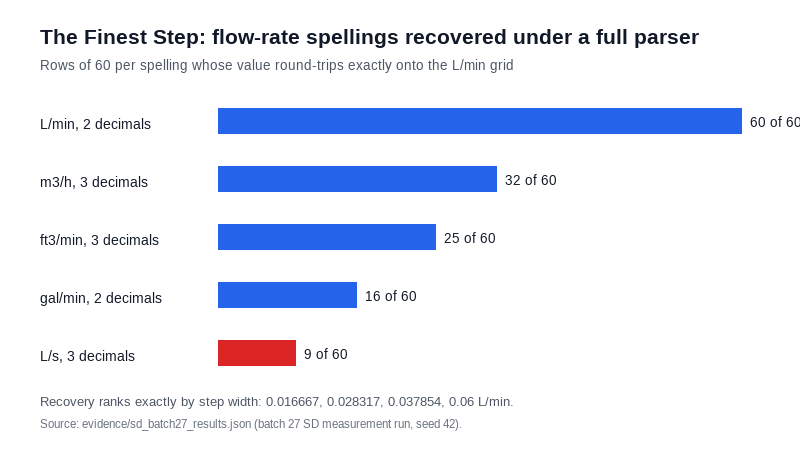
A plant engineer inherits a flow register kept in litres per minute and a folder of supplier datasheets written every other way: litres per second, cubic metres per hour, gallons per minute, cubic feet per minute. The first merge a beginner runs on this material follows a sensible-looking instinct — trust the small units, distrust the big ones — and it fails in the order the instinct predicts least. Run as a controlled measurement, with 300 flow rates on a two-decimal L/min grid written in all five spellings and parsed back with exact constants, the biggest unit in the set, cubic metres per hour, recovers 32 of its 60 rows, the best of any converted spelling. The smallest, litres per second, recovers 9. This article is the pitfall list from that merge, in the order a beginner meets them.
What The Finest Step means
The Finest Step is the condition in which the converted spelling that recovers the most values is the one whose step, expressed in the canonical unit, is the finest — regardless of the size of the unit it is counted in — so that recovery ranks exactly by step width and not by unit size, familiarity or decimal count. A flow rate exhibits it when its cubic-metre-per-hour spelling, at three decimals of a unit sixteen times larger than the canonical one, steps by 0.016667 L/min and out-recovers a litres-per-second spelling whose three decimals step by 0.06 L/min. The measurement behind this article generated 300 flow rates from 0.50 to 2,000.00 L/min (checksum of values 293,515.50), wrote each in five spellings, and matched two inventories under three parsers, using 1 m3/h = 16.6666667 L/min, 1 US gal/min = 3.785411784 L/min and 1 ft3/min = 28.3168466 L/min (Source: evidence/sd_batch27_results.json, group AN27).
The nearest prior concept is The Quantized Rate, which named data-rate spellings rounded onto lattices so coarse that some recovered nothing at all — a Gbps spelling at two decimals scored zero. The Finest Step is the same physics with the opposite moral. In The Quantized Rate the interesting rows were the zeros; here there are no zeros, every converted spelling recovers something, and the interesting fact is the perfect ordering: 32, 25, 16, 9, in exact step order 0.016667, 0.028317, 0.037854, 0.06. Where The Quantized Rate warns that a spelling can be a cliff, The Finest Step shows a staircase — and shows that the staircase is climbed by step width alone, with the largest unit standing on the finest stair.
Pitfall 1: trusting the smallest unit because it feels precise
The first pitfall is the instinct itself. Litres per second feels like the careful spelling: the unit is small, the numbers are short, three decimals are printed. Its step is three decimals of a sixtieth — converting back, one milli-unit of a litre per second is 0.06 L/min, six grid steps — and it recovers 9 of 60. The cause is that decimals are counted in the spelling's own unit, and a small unit with a time base sixty times shorter multiplies every decimal away: the third decimal of an L/s figure is worth sixty times its face value in L/min. Correct practice: never judge a spelling by the size of its unit or the count of its decimals; multiply the smallest printed increment by the full conversion factor, time base included, and compare that step with the grid.
Pitfall 2: distrusting the biggest unit for the same reason in reverse
The second pitfall is the mirror error. Cubic metres per hour looks like the coarse spelling — a big volume unit, the kind of figure utilities round for billing — and a beginner either discards the block or parses it last. Its step is 0.001 of 16.6666667 L/min, which is 0.016667 L/min, under two grid steps, the finest of any converted spelling in the set, and it recovers 32 of 60, more than the other three converted spellings' neighbours combined would suggest. The cause of the pitfall is the same as the first: the conversion factor for m3/h is small enough, and its three decimals deep enough, that the product lands near the grid. Correct practice is identical, because the two pitfalls are one: compute the step, then rank.
Pitfall 3: assuming the imperial spellings are the problem
The third pitfall is blaming the foreign units. Gallons per minute recover 16 of 60 and cubic feet per minute 25 of 60 — mediocre, and a beginner files both under "imperial, therefore lossy" and moves on. The cause of their losses is not their origin but their steps: 0.037854 and 0.028317 L/min respectively, which place them second and third in the step ranking and second and third in the recovery ranking, ahead of the metric L/s block. A register that banned imperial spellings and kept L/s would keep its worst converted block and discard its second-best. Correct practice: rank all five spellings by computed step — m3/h 0.016667, ft3/min 0.028317, gal/min 0.037854, L/s 0.06 — and let the ranking, not the unit system, decide which blocks to trust, convert or re-request.
| Spelling | Step in L/min | Rows recovered of 60 |
|---|---|---|
| L/min, 2 decimals | 0.01 | 60 |
| m3/h, 3 decimals | 0.016667 | 32 |
| ft3/min, 3 decimals | 0.028317 | 25 |
| gal/min, 2 decimals | 0.037854 | 16 |
| L/s, 3 decimals | 0.06 | 9 |
> Source: evidence/sd_batch27_results.json (batch 27 SD measurement run, group AN27).
Pitfall 4: reading a clean merge report as a good merge
The fourth pitfall is auditing the wrong number. The full parser in this measurement recovers 142 of 300 rows and records zero false merges at every stage: every match it makes is correct. A beginner reads "no wrong matches" as success. The cause of the misreading is that loss and error are different failures and only one of them shows up in an accuracy check; 158 rows are present in both inventories and unmatched, and a report that counts only correctness will call the merge clean while half the register stands unmatched on both sides. Correct practice: report two numbers for every merge, matched and present-but-unmatched, and judge converted spellings by the second number.
The detour route: the example flow rate, taken the long way round
The run's example rate, 244.90 L/min, shows the detour a careful merger takes. Written canonically it matches at once. As "14.694 m3/h" it returns 244.90 exactly — the big unit, taken seriously, is a perfect copy. As "8.649 ft3/min" it returns 244.91, one hundredth high. As "4.082 L/s" it returns 244.92, and as "64.70 gal/min" it also returns 244.92. The detour route for the whole register follows from this row: convert the m3/h block first and bank its 32 exact rows, then the ft3/min block, and treat the L/s and gal/min blocks as approximations to be re-requested from source at higher precision, rather than as values to be merged.
Questions on The Finest Step, answered
1. Why does m3/h beat L/s when both print three decimals? Because the step is the decimal increment times the conversion factor: 0.001 x 16.6666667 = 0.016667 L/min for m3/h, against 0.001 x 60 = 0.06 L/min for L/s. The time base is part of the factor, and sixty beats sixteen.
2. Would more decimals fix L/s? Four decimals of L/s step by 0.006 L/min, finer than the grid, and would recover every row. The pitfall is not the unit but the printed precision relative to its factor.
3. Is the recovery order always exactly the step order? In this measurement, yes, across all four converted spellings. It need not be perfect in general — value distribution matters — but step width is the first-order predictor and the ranking here has no exceptions.
4. Why are there no false merges if so many values are lost? The lattices are coarse relative to the grid but the inventory is sparse on them, so rounded values land on empty grid points. Loss without misidentification is the normal failure of a coarse spelling; misidentification needs crowding, which these steps do not create.
5. Which spelling should the register standardise on for exports? Cubic metres per hour at three or more decimals, on this evidence: it is the only converted spelling whose step approaches the grid, and its exact rows can be recognised by any later reader who recomputes the step.
The pre-merge checklist
Five checks, run before the next datasheet folder is merged. One: list every spelling in the incoming files. Two: for each spelling, multiply its smallest printed increment by its full conversion factor, including any time-base change, to get its step in L/min. Three: rank the spellings by step and mark every spelling whose step exceeds the 0.01 grid as approximate. Four: merge the finest-step blocks first and report matched and present-but-unmatched as separate numbers. Five: for any block whose step exceeds the grid by more than five times, re-request the figures from the source at higher precision instead of merging them as values.