
The Inverted Merge: reciprocal fuel units produced 27 false merges, not just 202 lost rows
27 of the 300 rows in this measurement were not lost. They were matched to the wrong row. The measurement merges a fuel-consumption register recorded...
27 of the 300 rows in this measurement were not lost. They were matched to the wrong row. The measurement merges a fuel-consumption register recorded in litres per 100 kilometres against copies of itself written in five spellings, three of them reciprocal units — kilometres per litre and miles per gallon, US and UK — in which the value is turned upside down before it is rounded. Under the strongest parser, 98 rows match themselves, 202 are lost, and 27 matches are false: a consumption figure was identified as a different figure's row. Every other group in this batch loses values without misidentifying them, or misidentifies one row at most. The reciprocal spellings are the only ones that manufacture wrong matches at scale, because rounding an inverted number moves it onto other values' ground.
What The Inverted Merge means
The Inverted Merge is the condition in which a value written in a reciprocal unit — one defined as a constant divided by the value, as km/L and mpg are defined against L/100km — rounds onto the reciprocal image of a different recorded value, so that a merge identifies the row as that other value instead of losing it. It arises because rounding in inverted space is not symmetric: the step between neighbouring mpg figures, expressed back in L/100km, grows as consumption rises — a tenth of an mpg is worth 0.0038 L/100km at 3 L/100km and 0.2629 L/100km at 25 L/100km — so at the thirsty end of the register the rounded reciprocals are crowded with other values' images. The measurement behind this article generated 300 consumption figures from 3.00 to 25.00 L/100km on a two-decimal grid (checksum of values 4,332.28), wrote each in five spellings, and matched two inventories under three parsers, using 100 / value for km/L, 235.214583 / value for US mpg and 282.480936 / value for UK mpg (Source: evidence/sd_batch27_results.json, group AN26).
The nearest prior concept is The Reciprocal Pair, which named two pricing tables produced from a main table by factors that are exact reciprocals of each other, 0.5 and 2.0, so the transformations cancel and nothing is lost. The Inverted Merge is what reciprocals do when they meet rounding instead of exact arithmetic. The Reciprocal Pair's factors are applied to whole tables and cancel perfectly; a fuel figure's reciprocal is rounded to one decimal of an mpg before anyone converts it back, and the rounding does not cancel — it relocates the value, sometimes onto a neighbour. One concept is reciprocity as symmetry. The other is reciprocity as a collision mechanism.
1. The tier map: three parser tiers and what each is allowed to claim
The upgrade path for merging this register has three tiers, and the measurement prices each one. Tier one, exact string matching, goal: recover the canonical block and nothing else; it recovers 60 of 300 with zero false merges, and its pass criterion is that every match it claims is certainly right. Tier two, a direct parser that adds the one non-reciprocal converted spelling, millilitres per kilometre as integers, goal: recover the direct conversions; it reaches 66 with 4 false merges, and its pass criterion — no false merges — is already failed by the integer spelling alone, whose 0.1 L/100km step parks rounded values on neighbouring grid points. Tier three, the full parser, adds the three reciprocal spellings, goal: recover everything recoverable; it reaches 98 matched rows but 27 false merges, failing the criterion outright. The map's lesson is that the tiers do not ascend: the strongest parser is the least trustworthy one in the building.
2. The tier evidence: recovery by spelling under the full parser
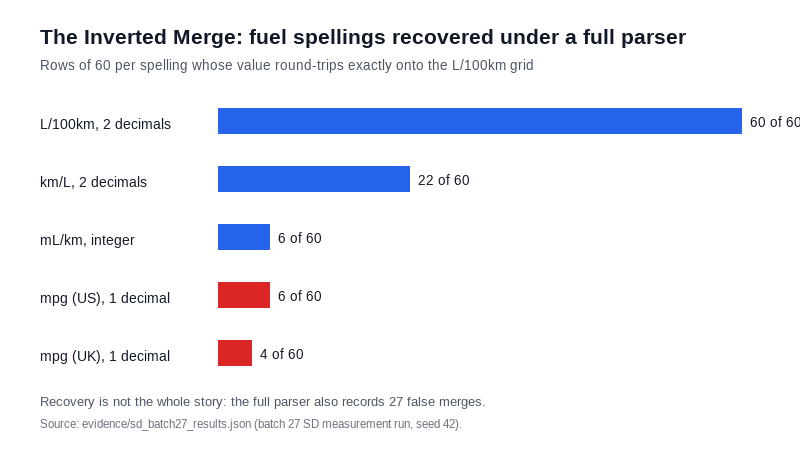
| Spelling | Kind | Rows recovered of 60 | Behaviour |
|---|---|---|---|
| L/100km, 2 decimals | canonical | 60 | exact |
| km/L, 2 decimals | reciprocal | 22 | best of the inverted forms |
| mL/km, integer | direct, step 0.1 | 6 | loses rows, causes collisions |
| mpg (US), 1 decimal | reciprocal | 6 | step widens as consumption rises |
| mpg (UK), 1 decimal | reciprocal | 4 | a different gallon, the same collisions |
> Source: evidence/sd_batch27_results.json (batch 27 SD measurement run, group AN26).
The reciprocal forms recover between 4 and 22 rows of 60 — poor, but in line with coarse spellings elsewhere. What separates this group is not the recovery column but the false-merge count: 4 at the direct tier and 27 at the full tier, against zero or one in every other group of this batch. A coarse direct spelling loses a value to an empty point on its own lattice. A coarse reciprocal spelling loses it into a crowd, because the reciprocal lattice is not evenly spaced in the canonical unit: near 3 L/100km, a tenth of an mpg is worth 0.0038 L/100km, finer than the grid itself, while near 25 L/100km the same tenth of an mpg is worth 0.2629 L/100km, twenty-six grid steps — neighbouring thirsty values have nearly identical reciprocals, so their rounded spellings coincide, and where the images bunch, they collide.
3. The upgrade gates: what must be true before a tier may be used
Three gates stand between the tiers. Gate one, before leaving exact matching: the merge report must state matched and unmatched as separate numbers, so that a later tier's gains are never confused with its inventions. Gate two, before enabling any converted spelling: a sample of known values must round-trip through the spelling with zero false identifications, not merely a high recovery — the mL/km block fails this gate, since its collisions appear before the reciprocal forms are even switched on. Gate three, before enabling reciprocal spellings: the register must carry, for each reciprocal-sourced row, the original string beside the converted value, because a converted reciprocal cannot be audited after the fact — two different originals can produce the same converted figure, and the merge cannot tell which one it is holding. A tier that cannot pass its gate is not a weaker tool; it is a source of confident wrong rows.
4. Worked example: 10.08 L/100km in five spellings, and where each lands
The run's example figure, 10.08 L/100km, shows the whole pathology in one row. As "10.08 L/100km" it matches exactly. As "9.92 km/L" it returns 10.08 and recovers — the one reciprocal spelling fine enough, at two decimals, to land home. As "101 mL/km" it returns 10.10, a miss of two hundredths that is also another row's value whenever the register holds a 10.10, which is precisely how the direct tier's false merges happen. As "23.3 mpg" (US) it returns 10.10 again. As "28.0 mpg (UK)" it returns 10.09, missing by one hundredth in the opposite direction from the km/L form's exactness. Three of the four converted spellings place this figure on values that are not its own, and two of them place it on the same wrong value by different routes, so a merge that saw both would find them agreeing with each other against the register.
Questions on The Inverted Merge, answered
1. Why do reciprocal spellings collide when direct coarse spellings mostly do not? Direct coarse spellings round onto their own evenly spaced lattice, which is sparse relative to the register, so rounded values usually land on empty points. Reciprocal spellings round onto a lattice that is uneven in canonical units and crowded at the high-consumption end, where neighbouring values share nearly identical reciprocals, so rounded values land on other values' points.
2. Is the US or UK gallon the bigger problem? Neither; they recover 6 and 4 rows respectively and collide by the same mechanism. The gallon's size changes the constant, not the geometry. The problem is the inversion, not the empire.
3. Why did the direct tier already have 4 false merges? The mL/km integer spelling steps by 0.1 L/100km, ten grid steps, and its rounded outputs coincide with other rows' values often enough to misidentify four. Reciprocity multiplies the effect; it does not invent it.
4. Can a tolerance-based matcher fix the reciprocal blocks? It would convert false merges into ambiguous ones, which is an improvement in honesty but not in recovery: at the crowded end, several recorded values sit within any usable tolerance of a rounded mpg figure, and no matcher can know which one the figure was.
The decision rule
Never merge on a reciprocal spelling without its original string attached: a converted km/L or mpg figure may be used to find a candidate row, never to confirm one, and any merge whose parser reports false merges in double digits is rejected as a whole, however many rows it recovers. Recovery can be improved by better spellings; misidentification can only be prevented by refusing to let an inverted, rounded number testify alone.