
The Missing Rungs: the spellings that write voltage smallest are the only ones that keep it
Intuition says a voltage written in microvolts, a unit a million times smaller than the volt, is where precision goes to die — the number is nine digi...
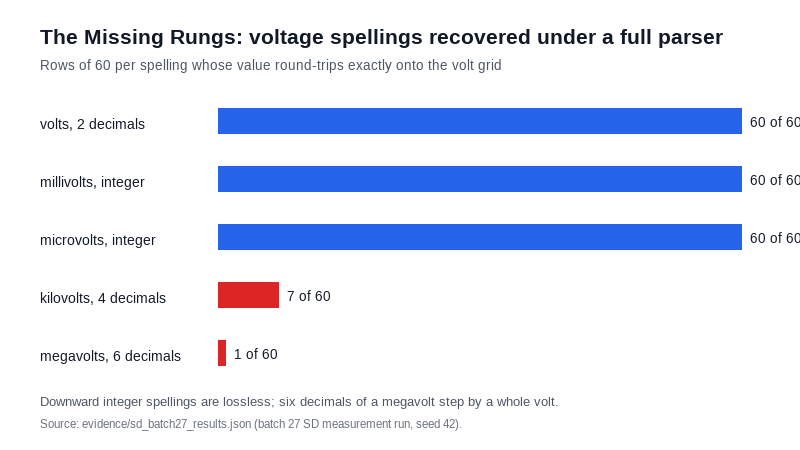
Intuition says a voltage written in microvolts, a unit a million times smaller than the volt, is where precision goes to die — the number is nine digits long and nobody can read it. The measurement says the opposite. Three hundred voltages on a two-decimal volt grid were written five ways and parsed back: the microvolt spelling, all nine digits of it, returns every one of its 60 values exactly, and so does the millivolt spelling. The spellings that fail are the ones that write voltage largest. Kilovolts at four decimals return 7 of 60. Megavolts at six decimals — six decimals, the most precise-looking string in the set — return 1 of 60. The prefix ladder is intact on the way down and missing its rungs on the way up.
What The Missing Rungs means
The Missing Rungs is the condition in which a family of prefixed spellings is lossless in the downward direction and lossy in the upward direction, because downward spellings written as integers step more finely than the recording grid while upward spellings, at the decimal counts sources actually print, step more coarsely than it. A voltage exhibits it when its millivolt and microvolt spellings round-trip exactly while its kilovolt and megavolt spellings do not: one millivolt steps by 0.001 V and one microvolt by 0.000001 V, both finer than the 0.01 V grid, while four decimals of a kilovolt steps by 0.1 V and six decimals of a megavolt steps by exactly 1 V. The measurement behind this article generated 300 voltages from 0.50 to 500.00 V (checksum of values 76,650.55), wrote each in five spellings, and matched two inventories under three parsers, using exact powers of a thousand between prefixes (Source: evidence/sd_batch27_results.json, group AN25).
The nearest prior concept is The Whole-Number Gate: in that earlier case, one spelling's finest increment was the canonical unit itself, a full watt, and nothing but whole-watt values could cross it. The megavolt block in this group is the same device in volts — a 1 V increment, one survivor in 60 — but the gate is not the finding here. In the gate's own group it stood by itself. The Missing Rungs names the pattern across the ladder: the same gate, widening rung by rung upward (0.1 V at kilovolts, 1 V at megavolts) while the downward rungs are not gates at all. A troubleshooter who knows only the gate will check the megavolt block and stop; the rungs are the reason the kilovolt block, which looks safe at four decimals, is also broken.
1. The symptom: 188 of 300 matched, and the failures cluster at the top of the ladder
The merge symptom is lopsided. Exact matching recovers the 60 canonical rows. A decimal parser that handles volts, millivolts and kilovolts reaches 127: all 60 millivolt rows, 7 kilovolt rows. The full parser, adding microvolts and megavolts, reaches 188, and records the batch's only false merge in this group — one row matched to a neighbour's value at the full-parse stage, a reminder that the coarse upward spellings do not merely lose values but can park a rounded value on top of another row's grid point. The 112 unrecovered rows sit almost entirely in two blocks: 53 of 60 kilovolt rows and 59 of 60 megavolt rows. Nothing about the values themselves distinguishes the lost rows; their voltages are ordinary. Their spellings are the symptom.
2. The diagnostic tree: three questions that locate the loss
| Question | Branch | Reading |
|---|---|---|
| Is the spelling's unit smaller than the volt? | Yes → integer millivolt or microvolt spelling | Step 0.001 V or finer: lossless, expect 60 of 60 |
| Is the unit the volt itself? | Yes → two-decimal spelling | The canonical form: lossless by definition |
| Is the unit larger than the volt? | Kilovolt → step 0.1 V at 4 decimals | Expect about 7 of 60 |
| Is the unit larger than the volt? | Megavolt → step 1 V at 6 decimals | Expect whole volts only: 1 of 60 here |
> Source: evidence/sd_batch27_results.json (batch 27 SD measurement run, group AN25).
The tree's first branch is the one intuition gets wrong. A smaller unit does not endanger an integer spelling; it protects it, because the integer count in a smaller unit is a finer instrument than the grid. The tree's last branch is the one presentation gets wrong: "0.000350 MV" carries six decimal places and looks like the most careful string in the file, and its step is a full volt, a hundred grid steps. Decimal places are counted from the unit, and the unit is doing the damage.
3. Locate and fix: the example voltage, taken rung by rung
The run's example voltage, 349.88 V, demonstrates every branch of the tree in one row. As "349.88 V" it matches exactly. As "349880 mV" it returns 349.88 exactly — the downward integer spelling is a perfect copy. As "349880000 uV" it also returns 349.88 exactly, nine digits and no loss. As "0.3499 kV" it returns 349.90, two hundredths high: the fourth decimal of a kilovolt is a tenth of a volt, and 349.88 rounds to the nearest tenth, 349.9. As "0.000350 MV" it returns 350.00, twelve hundredths high, the nearest whole volt. The fix, once the loss is located, is not a better parser — the full parser already converts exactly — but a better spelling: the same voltage requested in millivolts arrives losslessly, and any kilovolt figure already held should be carried as approximate to within 0.1 V, any megavolt figure to within 1 V, rather than merged as a value.
4. Recurrence prevention: audit the ladder, not the values
Preventing the next occurrence means checking spellings against the ladder before a merge, in three habits. First, for every prefixed spelling in an incoming file, compute its step in volts and compare it with the grid; any upward spelling whose step exceeds the grid is flagged as a summary, not a value. Second, prefer downward spellings in the register's own exports: a voltage written as an integer count of millivolts or microvolts can be recovered by any future reader exactly, at the cost of longer strings. Third, when a source will only supply kilovolts or megavolts, record the step beside the value in the register, so the next merge inherits the knowledge that the figure is a rung-wide approximation instead of rediscovering it as a mismatch.
Questions on The Missing Rungs, answered
1. Why does the microvolt spelling not overflow or blur at nine digits? Because it is an integer count. Integers do not round; 349,880,000 microvolts is exactly 349.88 V, and every value on a two-decimal volt grid has an exact integer microvolt count. The length of the string is a readability cost, not a precision cost.
2. How many decimals of a kilovolt would the grid need? Five decimals step by 0.01 V, exactly the grid, and would recover every value. Four decimals — the count datasheets print — steps by 0.1 V and recovered 7 of 60. The missing rung is a single decimal place.
3. What caused the one false merge? At the full-parse stage, a rounded upward spelling landed on a grid point belonging to another row, so one voltage was matched to a neighbour's value. It is the coarse blocks' second failure mode: mostly they lose values, occasionally they borrow one.
The one-sentence conclusion
On a prefixed ladder, trust is directional: integer spellings in smaller units keep a voltage exactly, decimal spellings in larger units keep it only as well as their step allows, and six decimals of a megavolt is a whole-volt approximation wearing a precise costume.