
The Thousand Step: a density register merged in five spellings matches 81 of its own 300 rows
A materials laboratory keeps its density register in kilograms per cubic metre, recorded to two decimals. A supplier's catalogue arrives with the same...
A materials laboratory keeps its density register in kilograms per cubic metre, recorded to two decimals. A supplier's catalogue arrives with the same class of materials written in grams per cubic centimetre, the unit the industry actually prints, and a second supplier writes grams per litre. The lab converts everything into its own unit and merges the files. The merge is run as a controlled measurement here: 300 densities on a two-decimal kg/m3 grid, five spellings, three parsers of increasing strength. The strongest parser, converting every spelling with exact constants, matches 81 of the 300 rows to themselves — the lowest full-parse recovery in this batch of measurements. Every converted spelling loses almost every row, including the two that change the value by nothing but a decimal point's position.
What The Thousand Step means
The Thousand Step is the condition in which a spelling that differs from the canonical unit only by a power of a thousand — grams per cubic centimetre or kilograms per litre against kilograms per cubic metre — quantizes values onto a lattice a thousand grid steps wide, because its printed precision, counted in its own small unit, runs out three orders of magnitude early. A density exhibits it when its g/cm3 or kg/L spelling, printed at four decimals, converts back to a different kg/m3 value than the one recorded: four decimals of a g/cm3 is a step of 10 kg/m3 on a grid of 0.01, which is a thousand grid steps per printed step. The measurement behind this article generated 300 densities from 100.00 to 20,000.00 kg/m3 (checksum of values 2,974,205.83), wrote each in five spellings, and matched two inventories under three parsers (Source: evidence/sd_batch27_results.json, group AN24).
The nearest prior concept is The Coarse Tonne, which named a mass spelling whose smallest step, a ten-thousandth of a tonne, was ten times the recording grid, so only values landing on that coarse lattice survived. The Thousand Step is the same failure at a hundred times the width, and with a twist the tonne did not have: two of this group's spellings, g/cm3 and kg/L, print the identical digit string for every value — the example density is "8.7518" in both — and return the identical wrong answer, so a register can hold the same digits twice, in two different units, and be wrong in both. The Coarse Tonne's coarse spelling was also the largest unit in its set. Here the coarsest spellings are the smallest units on the page, shrunk by a factor of a thousand and rounded as if nothing had changed.
Step 1: state the goal and the grid before touching the files
The goal of the procedure is a merged register in which every row can be matched back to its source row exactly. The prerequisite is knowing the recording grid: this register records densities to 0.01 kg/m3, so any incoming spelling whose step in kg/m3 exceeds 0.01 will lose rows, and the loss can be predicted before a single value is converted. Pass criterion for this step: the step of every incoming spelling is written down in canonical units. In the measurement, the five steps are 0.01 (kg/m3 itself), 10 (g/cm3 at four decimals), 0.1 (g/L at one decimal), 0.16018 (lb/ft3 at two decimals) and 10 (kg/L at four decimals).
Step 2: run exact matching and count what the canonical spelling alone recovers
Exact string matching recovers 60 of 300 rows — the block that was already written in kg/m3 at two decimals — and nothing else. This is the baseline every later stage is judged against, and it is also the audit trail: any parser stage that follows must beat 60 without inventing matches. Pass criterion: the exact stage recovers exactly the canonical block, no more and no less. The measurement's exact stage does so.
Step 3: apply the metric parser and watch the thousand-step spellings stall
A parser that handles the three metric spellings — kg/m3, g/cm3 and kg/L — raises the match count only to 71. The two thousand-step blocks contribute 11 rows between them: 3 from g/cm3 and 8 from kg/L, the values whose four-decimal spellings happened to land back on the grid. The parser is not failing; it converts with the exact factor of 1,000 and rounds correctly. The values it cannot recover were destroyed at the writing stage, when a density like 8,751.83 was rounded to "8.7518" and its final digit was discarded by a spelling that had no room for it. Pass criterion for this step: the metric stage's gains come only from the blocks it claims to parse, and the stall is attributed to step width, not to parser error.
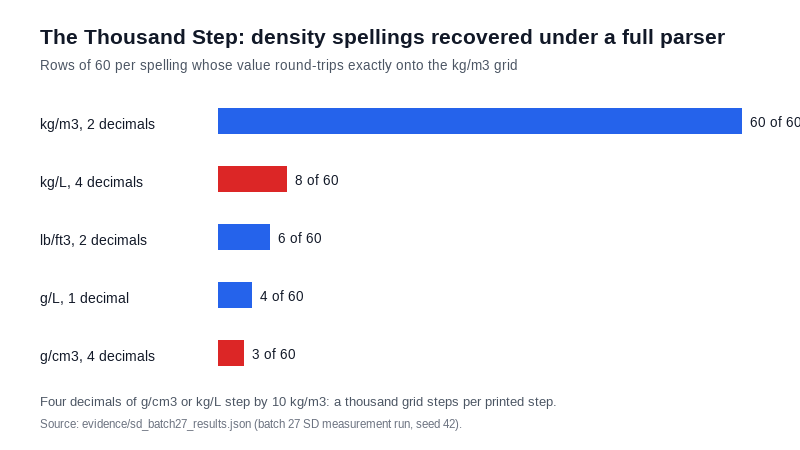
Step 4: apply the full parser and read the result table
| Spelling | Step on the kg/m3 grid | Rows recovered of 60 |
|---|---|---|
| kg/m3, 2 decimals | 0.01 kg/m3 | 60 |
| kg/L, 4 decimals | 10 kg/m3 | 8 |
| lb/ft3, 2 decimals | 0.16018 kg/m3 | 6 |
| g/L, 1 decimal | 0.1 kg/m3 | 4 |
| g/cm3, 4 decimals | 10 kg/m3 | 3 |
> Source: evidence/sd_batch27_results.json (batch 27 SD measurement run, group AN24).
The full parser, which adds the lb/ft3 conversion and the g/L identity (one gram per litre is exactly one kilogram per cubic metre), reaches 81 of 300, with zero false merges at every stage. Two details in the table deserve attention. The g/L block, whose unit is numerically identical to the canonical unit, recovers only 4 of 60, because it is printed at one decimal: identity of units does not rescue poverty of decimals. And the imperial spelling, lb/ft3, with the second-finest step, recovers 6 — better than g/cm3, worse than kg/L, and nowhere near the 60 that any step at or below the grid would have given. The completion check for the whole procedure is the pair of numbers 81 and 0: 81 rows recovered, 0 rows misidentified. The register's problem is loss, not error, and loss of this size is a property of the spellings, not of the merge.
Step 5: work one density through all five spellings
The run's example density, 8,751.83 kg/m3, survives only in its canonical spelling. As "8.7518 g/cm3" it returns 8,751.80, three hundredths low. As "8.7518 kg/L" — the identical digits — it returns the identical 8,751.80. As "8751.8 g/L" it returns 8,751.80 again, a third route to the same wrong value. As "546.36 lb/ft3" it returns 8,751.85, two hundredths high, the only spelling that misses upward. A technician reconciling this row by eye would find three converted copies agreeing with each other at 8,751.80 and might reasonably conclude the canonical 8,751.83 was the typo. Agreement among converted spellings is not evidence; here it is the signature of a shared rounding.
Questions on The Thousand Step, answered
1. Why do g/cm3 and kg/L produce identical digit strings? Because both units are exactly one thousand times the canonical one: dividing by 1,000 either way gives the same digits. The strings match each other perfectly and both round at the same place, which is why both return 8,751.80 for the example row.
2. Would five decimals of g/cm3 fix the block? It would reduce the step to 1 kg/m3, still a hundred grid steps, recovering roughly the values that are whole numbers of kg/m3. Six decimals, stepping by 0.1, and seven, stepping by the grid itself, are what full recovery requires — precisions no catalogue prints.
3. Why does lb/ft3 beat g/cm3 despite being a foreign unit? Its step, 0.01 of a lb/ft3, is 0.16018 kg/m3 — coarse, but sixty times finer than the thousand-step spellings. Unit systems do not decide these outcomes; step widths do.
4. Are any rows matched to the wrong material? No. The run records zero false merges at all three parser stages. The lattice points the rounded values land on are empty, so the failure appears as absence, not as misidentification.
The next action
Before the next catalogue is merged, compute each spelling's step in kg/m3 and refuse, in writing, any spelling whose step exceeds the grid: request densities in kg/m3, or in g/cm3 at six or more decimals, and treat every four-decimal g/cm3 or kg/L figure already in the register as approximate to within 10 kg/m3 rather than as a value. The next action is a standing rule for incoming files, not a repair of this one, because the 219 lost rows cannot be repaired from the spellings that lost them.