
The Borrowed Gravity: the kilogram-force metre carries gravity inside its own conversion
A torque rating written in kilogram-force metres looks like the most physical spelling in this test: it is built from a kilogram, a metre, and the Ear...
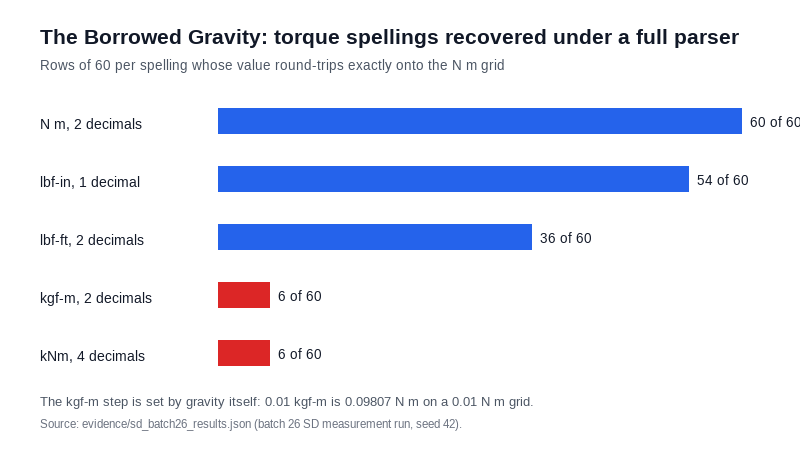
A torque rating written in kilogram-force metres looks like the most physical spelling in this test: it is built from a kilogram, a metre, and the Earth's gravity that binds them. It is also nearly the worst spelling in the test. Six of 60 ratings written in kgf-m survive conversion back to newton metres, the same score as the kilonewton metre at four decimals, while the humble pound-inch, a unit from a different system and a different century, recovers 54 of 60. The reason is hiding inside the unit itself. A kilogram-force is defined through standard gravity, 9.80665, so every hundredth of a kgf-m steps by 0.09807 N m on a grid of 0.01 N m. The unit borrowed gravity to define itself, and the loan makes its step land almost never on the grid its values are recorded on.
What The Borrowed Gravity means
The Borrowed Gravity is the condition in which a unit defined through standard gravity, the kilogram-force and its compounds, imposes a conversion step set by 9.80665, so values written in that unit at ordinary precision fall between the points of the grid they must return to. A torque exhibits it when its kgf-m spelling converts back to a different newton-metre value than the one recorded. The measurement behind this article generated 300 torque ratings on a newton-metre grid of two decimals, from 0.50 to 2,000.00 N m (checksum of values 308,398.03), wrote each in five spellings, and matched two inventories under three parsers (Source: evidence/sd_batch26_results.json, group AN23).
The nearest prior concept is The Compound Inch, which covered lengths written in compound feet-and-inches expressions where every writing was exact and only the parsing was hard. Torque's kgf-m presents the reverse problem in a neighbouring trade: the string is a plain decimal number with a unit label, trivial to parse, and the value itself is what cannot be written exactly. A fitter reaching for a kgf-m wrench chart is not fighting notation. The number on the chart was rounded by gravity before it was printed.
1. The definition, stated precisely
A kilogram-force is the force of standard gravity on one kilogram, exactly 9.80665 N by definition. A kilogram-force metre is therefore exactly 9.80665 N m. When a torque is written in kgf-m at two decimals, the writable values form a lattice spaced 0.01 x 9.80665 = 0.09807 N m apart. The recording grid for torque in this measurement, and in most engineering data, is 0.01 N m. The lattice spacing is 9.8 grid steps, and it is not a whole number of grid steps, so the lattice points drift against the grid: a value that lands on a grid point is followed by values that land between points, and only about one rating in ten can be written exactly. That is the whole mechanism. No approximation is involved in the constant; the loss is manufactured by exact arithmetic.
2. What falls inside: the five spellings and their fates
| Spelling | Step on the N m grid | Rows recovered of 60 |
|---|---|---|
| N m, 2 decimals | 0.01 N m | 60 |
| lbf-in, 1 decimal | 0.0113 N m | 54 |
| lbf-ft, 2 decimals | 0.01356 N m | 36 |
| kgf-m, 2 decimals | 0.09807 N m | 6 |
| kNm, 4 decimals | 10 N m | 6 |
> Source: evidence/sd_batch26_results.json (batch 26 SD measurement run, group AN23).
Stage totals: exact string matching recovers 60 of 300; an SI parser converting newton metres and kilonewton metres recovers 66; the full parser recovers 162 of 300, with no false merges at any stage. Inside the concept's scope sit the kgf-m block, 6 of 60 recovered, and, by a different route, the kNm block: its step is a round 10 N m, so only ratings that are whole multiples of 10 N m survive, 6 of 60. The two pound spellings sit at the boundary: their steps, 0.0113 and 0.01356 N m, are close enough to the grid step that most ratings land back on their own points after rounding, 54 and 36 of 60 respectively.
3. What falls outside: near misses that are not this concept
Three neighbours must be kept outside the definition. First, ordinary unit unfamiliarity: a reader who does not know what a kilogram-force is has a training problem, not a borrowed-gravity problem; the concept applies when the conversion is known and performed exactly, and the value still moves. Second, the kNm block's failure: it shares the symptom, a coarse step, but its step comes from a metric prefix, not from gravity, and it is cured by decimals rather than by abandoning the unit. Third, rounding in display: a torque shown to a human as a whole number of kgf-m for readability is a presentation choice; the concept bites when the rounded spelling is stored or exchanged as the value itself, because then the rounding becomes the record.
4. The boundary table: when each spelling is safe
| Condition | Safe spellings | Unsafe spellings |
|---|---|---|
| Grid 0.01 N m, values under 2,000 N m | N m 2dp; lbf-in 1dp (54 of 60) | kgf-m 2dp; kNm 4dp |
| Grid 0.1 N m | N m; lbf-ft 2dp; kgf-m 2dp (step 0.098 close to grid) | kNm 4dp |
| Values above 10,000 N m | kNm gains decimals of headroom | kgf-m unchanged, gravity does not scale away |
| Exchange with legacy kgf-m sources | Convert on ingest, keep N m as record | Storing the kgf-m string as the value |
The boundary turns on the ratio between the spelling's step and the grid. Ratios near 1 are safe. The kgf-m ratio at a 0.01 grid is 9.8, and because 9.80665 is not a round number, raising the grid's coarseness to 0.1 N m brings the ratio near 1 and largely disarms the concept, which is why legacy kgf-m data recorded coarsely survives better than fine modern data converted into it.
5. Worked example: 1,705.73 N m in five spellings
The run's example rating, 1,705.73 N m, splits the spellings cleanly. As "1705.73 Nm" it matches exactly. As "15097.0 lbf-in" it returns 1,705.73 N m. As "1258.08 lbf-ft" it also returns 1,705.73 N m, this rating happening to sit near a pound-foot lattice point. As "173.94 kgf-m" it returns 1,705.77 N m, four grid steps high: the nearest writable kgf-m values straddle the rating, and the nearer one is still 0.04 N m away. As "1.7057 kNm" it returns 1,705.70 N m, three grid steps low. A torque wrench set from the kgf-m chart value would be set 0.04 N m off this rating's record; trivial for one bolt, systematic across a fleet whose records were all converted the same way.
Questions on The Borrowed Gravity, answered
1. Why does the pound-inch outperform the kilogram-force metre? Its step, a tenth of a pound-inch, is 0.0113 N m, close to the 0.01 N m grid, so rounding errors are smaller than half a grid step for most ratings. Proximity of step to grid, not the unit's pedigree, decides survival.
2. Would three decimals of kgf-m fix the block? Yes. Three decimals step by 0.00981 N m, just under the grid step, so essentially every rating would round-trip. The failure belongs to two decimals, the precision legacy charts actually use.
3. Does the effect shrink for small torques? No. The step is constant, so a 5 N m rating written as "0.51 kgf-m" returns 5.00 N m and one written as "0.52 kgf-m" returns 5.10 N m; at small values the relative error is at its worst.
4. Are there other gravity-borrowing units in ordinary data? The kilogram-force family itself: kgf, kgf-m and kgf/cm2 in pressure data from older equipment. Any of them carries the 9.80665 step into whatever grid it meets.
The one-line test
Before accepting a torque in kgf-m, multiply its last decimal place by 9.80665: if the result is not close to your recording grid's step, the spelling cannot hold your values, and in this measurement it held six of sixty.