
The Rounded Horse: not one of 60 power ratings survives being written in horsepower
A facilities team keeps its equipment register in watts, recorded to a tenth of a watt. A vendor catalogue arrives listing the same class of equipment...
A facilities team keeps its equipment register in watts, recorded to a tenth of a watt. A vendor catalogue arrives listing the same class of equipment in horsepower at two decimals, the industry-standard way to print it. The team converts the catalogue values into watts to merge the two lists, and the merge quietly fails for every converted row: not some of them, not most of them, all of them. This article is the postmortem of that failure, run as a controlled measurement: 300 power ratings on a watt grid, five spellings, three parsers, and a full-parser recovery of 78 of 300, the worst in this batch of measurements. The horsepower block and the megawatt block each recovered zero rows.
What The Rounded Horse means
The Rounded Horse is the condition in which a power rating written in horsepower at ordinary catalogue precision cannot express the rating's recorded value, because one hundredth of a horsepower is a step of 7.457 watts on a grid of a tenth of a watt. A rating exhibits it when its horsepower spelling converts back to a different wattage than the one recorded. The measurement behind this article generated 300 ratings on a watt grid of one decimal, from 5.0 to 60,000.0 W (checksum of values 8,940,979.7), wrote each in five spellings, and matched two inventories under three parsers, using 1 hp = 745.699872 W and 1 BTU/h = 0.29307107 W (Source: evidence/sd_batch26_results.json, group AN21).
The nearest prior concept is The Whole-Number Gate, which named a spelling whose smallest step equals the whole canonical unit, so only whole-unit values pass through it. The Rounded Horse is a harsher relative. Its gate is not the whole unit but an awkward multiple of it, 7.457 W, set by the definition of the horsepower itself, and it stands next to a second gate of a completely different kind in the same test: the megawatt block fails not on an irrational step but on a round one, 10 W, because five decimals of a megawatt is still a coarse way to write a watt-scale rating. Two different mechanisms, one shared outcome of zero.
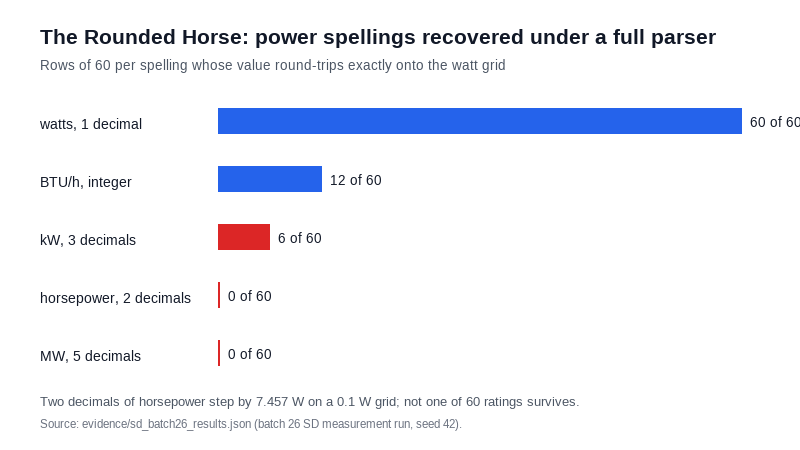
1. The incident: a merge that matched 78 of 300
The incident, reconstructed from the measurement, is a routine inventory merge. One list in canonical watts at one decimal. The other list spread across the spellings real sources use: watts at one decimal, kilowatts at three decimals, horsepower at two decimals, megawatts at five decimals, and BTU per hour as integers. After exact string matching, only the 60 canonical rows matched. After a metric parser, 66. After the strongest parser, which converts every spelling with exact constants, 78 of 300 ratings could be matched to themselves. The remaining 222 were present in both lists, correctly converted, and unmatchable, because conversion had moved them off their own values.
2. The timeline: where the ratings were lost, stage by stage
The loss happened in three instalments. At the writing stage, before any parser ran, four of the five spellings rounded the ratings onto lattices coarser than the grid: kilowatts at three decimals onto a 1 W lattice, BTU/h integers onto a 0.293 W lattice, horsepower onto a 7.457 W lattice, megawatts onto a 10 W lattice. At the parsing stage, the metric parser recovered the 6 kilowatt rows and nothing else that exact matching had missed, because the kilowatt lattice, at ten grid steps, lets only whole-watt ratings through, and the megawatt lattice lets through only multiples of 10 W, of which the run's block contained none that also matched. At the full-parse stage, the BTU/h block added 12 rows and the horsepower block added none. By the time anyone looked at the match rate, the damage was three stages old and belonged to the first one.
3. The root cause: steps of 7.457 W and 10 W against a 0.1 W grid
| Spelling | Step on the watt grid | Rows recovered of 60 |
|---|---|---|
| watts, 1 decimal | 0.1 W | 60 |
| BTU/h, integer | 0.293 W | 12 |
| kW, 3 decimals | 1 W | 6 |
| horsepower, 2 decimals | 7.457 W | 0 |
| MW, 5 decimals | 10 W | 0 |
> Source: evidence/sd_batch26_results.json (batch 26 SD measurement run, group AN21).
The root cause is arithmetic, not carelessness. A rating on a 0.1 W grid survives a spelling only if the spelling's step divides the grid finely enough for the value to land back on its own point after rounding. The horsepower's step is fixed by its definition, 745.699872 W, a number with no tidy relationship to the watt grid, so a hundredth of a horsepower lands almost never on a tenth-of-a-watt point: 0 of 60 in this run. The megawatt's step is tidy, exactly 10 W, and equally fatal: only ratings that are whole multiples of 10 W could survive, and a one-decimal grid produces such ratings one time in a hundred by construction, none of which fell in this block. The kilowatt, stepping by exactly 1 W, passes the one-in-ten ratings that are whole watts, 6 of 60 here.
4. The damage in numbers: 222 ratings present and unmatchable
The cost of the incident is best stated as what a reconciliation report would show. Of 300 ratings, 222 appear as unmatched in both directions: the canonical list reports 222 ratings with no counterpart, and the converted list reports 222 values that match nothing, although all 300 pairs describe the same equipment. No rating was matched to the wrong equipment; the run records zero false merges at every stage. The failure is therefore invisible to any check that only looks for wrong matches. A team auditing the merge for correctness would find every match correct and conclude the merge worked, while three quarters of the inventory stood unmatched on both sides.
5. Worked example: 7,338.3 W in five spellings
The run's example rating, 7,338.3 W, fails in all four converted spellings, each by a different amount. As "7338.3 W" it matches exactly. As "7.338 kW" it returns 7,338.0 W, losing the final 0.3 W to the kilowatt's whole-watt lattice. As "9.84 hp" it returns 7,337.7 W, 0.6 W low, the closest a hundredth-of-a-horsepower lattice point comes to this rating. As "0.00734 MW" it returns 7,340.0 W, 1.7 W high. As "25039 BTU/h" it returns 7,338.2 W, a tenth of a watt low, the nearest miss of the four and still a miss. A rating does not have to be exotic to be unrepresentable: 7,338.3 W is an ordinary mid-range value, and four ordinary spellings each move it.
Questions on The Rounded Horse, answered
1. Would three decimals of horsepower fix the block? Largely. Three decimals step by 0.746 W, still coarser than the 0.1 W grid, so recovery would rise but not complete. Four decimals, stepping by 0.0746 W, would complete it.
2. Why does the megawatt block score zero with five decimals? Because the decimals are counted from the megawatt. Five decimals of a megawatt is a 10 W step, a hundred grid steps. Decimal counts mean nothing until they are multiplied by the unit.
3. Is BTU/h a good spelling for watt ratings? Better than its reputation here: its integer step, 0.293 W, is the finest of the four converted spellings, and it recovered 12 of 60. It is still three grid steps wide, so most ratings miss.
4. Why are there no false merges in such a lossy run? The lattices are coarse but the inventory is sparse relative to them, so rounded values land on empty grid points rather than on other ratings' points. Density, not coarseness alone, decides whether loss becomes misidentification.
The preventive checklist
Before the next merge, run five checks. One: list every spelling in the incoming file and compute its step in the canonical unit. Two: flag any spelling whose step exceeds the recording grid; expect losses in proportion to the ratio. Three: convert a sample of known values through each flagged spelling and count exact round-trips before merging the whole file. Four: where a spelling fails, request the source in watts or at higher precision rather than repairing matches by proximity. Five: report the merge with two numbers, matched and present-but-unmatchable, so a lossy spelling shows up as a loss instead of as missing equipment.