
The Decimal Foot: an inch at one decimal survives conversion, a foot at one decimal mostly does not
It sounds backwards. Of the two imperial spellings in this test, the inch is the smaller unit and the foot the larger, yet the lengths written in inch...
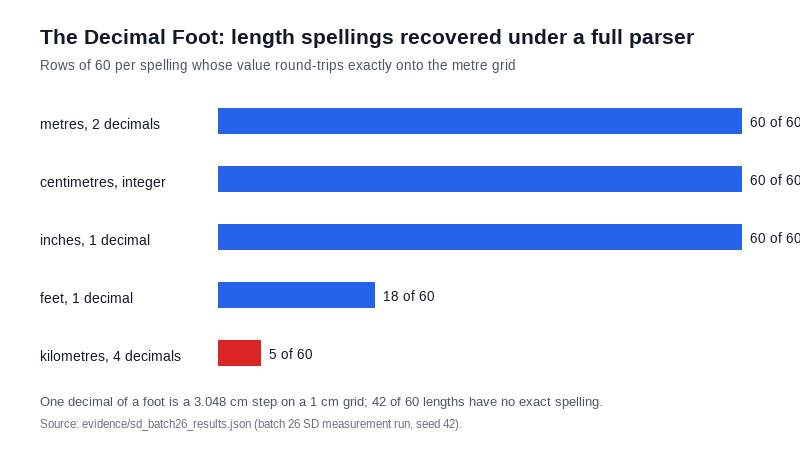
It sounds backwards. Of the two imperial spellings in this test, the inch is the smaller unit and the foot the larger, yet the lengths written in inches at one decimal place all survive conversion back to metres, and the lengths written in feet at one decimal place mostly do not. Sixty of 60 inch spellings round-trip exactly; only 18 of 60 foot spellings do. The difference is not the unit but the step the decimal place creates: one decimal of an inch is a step of 2.54 millimetres, finer than the one-centimetre grid the lengths were recorded on, while one decimal of a foot is a step of 3.048 centimetres, three times coarser than the grid. A decimal place is not a fixed amount of precision. It is a fraction of whatever unit it is attached to.
What The Decimal Foot means
The Decimal Foot is the condition in which a length written in decimal feet cannot express most values on a finer recording grid, because the smallest step of the spelling, a tenth of a foot, is wider than the grid step. A length exhibits it when its decimal-foot spelling converts back to a different length than the one recorded. The experiment behind this article generated 300 lengths on a metre grid of two decimals, from 0.30 to 500.00 m (checksum of values 76,489.60), wrote each in five spellings, and matched the two inventories under three parsers (Source: evidence/sd_batch26_results.json, group AN19).
The nearest prior concept is The Compound Inch, which covered lengths written as whole inches or as compound feet-and-inches expressions, where every writing was exact and the difficulty was purely in parsing the strings. The Decimal Foot is the opposite difficulty. Its strings are trivially easy to parse, a number and the letters ft, and the loss is inside the number itself: the value was rounded when it was written, before any parser saw it. A team can buy a perfect parser and still lose 42 of 60 lengths, because the information a parser would need was never written down.
1. The two sides: five spellings of the same 300 lengths
One inventory holds the lengths in the canonical spelling, metres at two decimals. The other holds the same 300 lengths in five blocks of 60: metres at two decimals, centimetres as integers, kilometres at four decimals, feet at one decimal, and inches at one decimal. The two sides being compared are therefore not two unit systems but two fates: spellings whose step is finer than the centimetre grid, and spellings whose step is coarser. Centimetres step by exactly the grid, 0.01 m. Inches step by 0.00254 m. Feet step by 0.03048 m. Kilometres at four decimals step by 10 m, the coarsest spelling in the test by a wide margin.
2. The same input through both sides: stage results
Exact string matching recovers 60 of 300 lengths, the canonical block. A metric parser, converting metres, centimetres and kilometres, recovers 125 of 300 with 1 false merge: the centimetre block completes, the kilometre block adds only the 5 lengths that happen to be whole multiples of 10 m. The full parser, adding feet and inches, recovers 203 of 300 with 1 false merge. The inch block completes in full, 60 of 60, because its step is a quarter of the grid step. The foot block adds 18. Nothing about the parsers distinguishes feet from inches; both are converted with exact constants, 1 ft = 0.3048 m and 1 in = 0.0254 m. The entire difference between the two imperial blocks is the size of a tenth.
3. The contrast table: recovery by spelling
| Spelling | Step on the metre grid | Rows recovered of 60 |
|---|---|---|
| metres, 2 decimals | 0.01 m | 60 |
| centimetres, integer | 0.01 m | 60 |
| inches, 1 decimal | 0.00254 m | 60 |
| feet, 1 decimal | 0.03048 m | 18 |
| kilometres, 4 decimals | 10 m | 5 |
> Source: evidence/sd_batch26_results.json (batch 26 SD measurement run, group AN19).
4. Where the difference comes from: step against grid
A spelling round-trips a grid value exactly when the value, expressed in the spelling's unit, lands within half a spelling step of a writable number and converts back onto the same grid point. With a step finer than the grid, every grid value qualifies. With a step three times the grid, as for decimal feet, only grid values that sit close to a multiple of 3.048 cm qualify, roughly one in three by geometry and 18 of 60 in this run. With a step a thousand times the grid, as for kilometres at four decimals on metre-scale lengths, only exact multiples survive, 5 of 60. The kilometre result and the foot result are the same phenomenon at different magnifications: the spelling's lattice is sparser than the grid, and most values fall between its points.
5. Worked example: 349.82 m in five spellings
The run's example length, 349.82 m, lands on both sides of the line. As "349.82 m" it matches exactly, and as "34982 cm" it converts back without loss. As "13772.4 in" it returns 349.82 m, the inch step being fine enough to hold it. As "1147.7 ft" it also returns 349.82 m: this length happens to sit near a tenth-of-a-foot lattice point, one of the lucky 18 in its block. As "0.3498 km" it returns 349.80 m, losing the last two centimetres, because four decimals of a kilometre cannot express them. The same length is thus exactly writable in four of its five spellings, and the one failure comes from the spelling that looks most precise, a four-decimal number.
Questions on The Decimal Foot, answered
1. Would two decimals of a foot fix the block? Almost entirely. Two decimals step by 0.003048 m, finer than the centimetre grid, so nearly every length would round-trip. The failure belongs to the pairing of feet with one decimal, not to feet.
2. Why do inches at one decimal beat feet at one decimal? Because a tenth of an inch, 2.54 mm, is smaller than a centimetre, while a tenth of a foot, 3.048 cm, is larger. The decimal count is the same; the step it creates is twelve times different.
3. Is the kilometre block's failure the same problem? Yes, at larger scale. Four decimals of a kilometre step by 10 m on a grid of 0.01 m, so only lengths that are whole multiples of 10 m survive, 5 of 60 in this run.
4. What is the false merge in the length run? One converted spelling landed exactly on a different length's grid value, so a parser matched it to the wrong record. Coarse spellings create wrong matches as well as lost ones.
The selection rule
Choose the spelling by its step, not by its unit or its decimal count. Before exchanging lengths, compute the step the spelling creates, unit size times ten to the minus decimals, and require it to be no larger than the grid the lengths were recorded on. Feet at one decimal fail that test against a centimetre grid; feet at two decimals and inches at one decimal pass it. When a partner system insists on a spelling whose step is too coarse, treat the exchange as approximate by design and reconcile on rounded values deliberately, rather than discovering the rounding record by record.