
The Coarse Tonne: written in tonnes at four decimals, a mass loses its last 50 grams
A warehouse system stores a consignment at 665.25 kg. The export file writes the same consignment as 0.6653 t, because the receiving system asked for...
A warehouse system stores a consignment at 665.25 kg. The export file writes the same consignment as 0.6653 t, because the receiving system asked for tonnes at four decimals. When the receiving system converts the value back, the consignment weighs 665.30 kg. Nothing was mis-keyed and no unit was confused: 0.6653 is the correctly rounded tonne spelling of 665.25 kg. The 50 grams were not lost in transit or in conversion. They were lost at the moment of writing, because four decimals of a tonne is a step of 100 grams, and the stored mass was recorded on a grid of 10 grams. This article measures how much of a mass inventory survives being written in five common spellings.
What The Coarse Tonne means
The Coarse Tonne is the loss that occurs when a mass is written in tonnes at a decimal precision whose step is coarser than the grid the mass was recorded on: each tonne spelling can name only every tenth grid value, so the other nine are rounded to a neighbouring mass or lost to matching. The measurement behind this article generated 300 masses on a kilogram grid of two decimals, from 1.00 to 1,500.00 kg (checksum of values 223,217.49), wrote each in five spellings, and matched two inventories of the same 300 masses under three parsers of increasing strength (Source: evidence/sd_batch26_results.json, group AN18).
The nearest prior concept is The Mismatched Ruler, which described two measuring forms whose steps disagree so that one form cannot express the other's values. The Coarse Tonne is a specific and more lopsided case: four of the five mass spellings are finer than the grid or equal to it, and exactly one, the tonne, is ten times coarser. The mismatch is not between two rulers of similar standing. It is between a unit so large that ordinary decimal precision cannot save it and the small units that surround it in the same file. A reader who checks only that the unit is metric will miss it entirely.
1. The test object: 300 masses on a two-decimal kilogram grid
Inventory A holds the 300 masses in the canonical spelling, kilograms at two decimals. Inventory B holds the same 300 masses spread across five spellings in blocks of 60: kilograms at two decimals, grams as integers, pounds at two decimals, ounces at one decimal, and tonnes at four decimals. The masses are synthetic and deterministic, produced by the script in the evidence folder with seed 42; the same script re-run reproduces the results file byte for byte. The question is not whether the spellings are legal, all five are, but whether a mass written in each spelling can be matched back to the same mass in the canonical inventory.
2. The method: three parsers, applied in stages
Matching was attempted in three stages. Exact string matching compares the spellings character for character. A metric parser converts the kilogram, gram and tonne spellings and leaves the imperial spellings unread. A full parser converts all five spellings, using 1 lb = 0.45359237 kg and 1 oz = 0.028349523125 kg, and rounds each result back to the two-decimal kilogram grid. A mass counts as recovered under a spelling when its converted value lands exactly on its original grid value. False merges, where one spelling's converted value lands on a different mass's grid value, are counted separately.
3. The result table: recovery by spelling under the full parser
| Spelling | Step on the kg grid | Rows recovered of 60 |
|---|---|---|
| kg, 2 decimals | 0.01 kg | 60 |
| grams, integer | 0.001 kg | 60 |
| pounds, 2 decimals | 0.00454 kg | 60 |
| ounces, 1 decimal | 0.00283 kg | 60 |
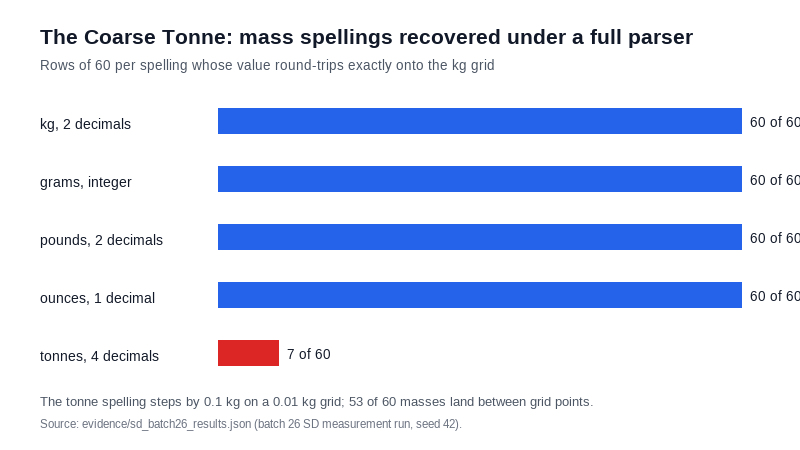
| tonnes, 4 decimals | 0.1 kg | 7 |
> Source: evidence/sd_batch26_results.json (batch 26 SD measurement run, group AN18).
Stage totals tell the same story from the matching side. Exact string matching recovers 60 of 300 masses, the canonical block only. The metric parser recovers 127 of 300 with 1 false merge, adding the gram block and the few tonne rows that land on grid points. The full parser recovers 247 of 300 with 1 false merge: every spelling completes except the tonne block, which contributes 7 of its 60. The entire shortfall of the full parser, 53 masses, sits in one block of one spelling.
4. Where the failures concentrate: the tenth-of-a-kilo step
Four spellings step more finely than the grid: an integer gram steps by 0.001 kg, an ounce at one decimal by 0.00283 kg, a pound at two decimals by 0.00454 kg. Any grid value can be written in those spellings and converted back to itself, because the rounding error is smaller than half a grid step. The tonne at four decimals steps by 0.1 kg, ten grid steps. Only masses whose last two decimals are a whole number of tenths, one in ten of them by construction and 7 of 60 in this run, have an exact tonne spelling at all. The remaining 53 are rounded to the nearest tenth, and one of them lands on a neighbouring mass's value, producing the run's single false merge: a wrong match that looks exactly like a right one.
5. Worked example: 665.25 kg in five spellings
The run's example mass, 665.25 kg, shows each fate. Written as "665.25 kg" it matches exactly. Written as "665250 g" it converts back to 665.25 kg without loss. Written as "1466.63 lb" it converts back to 665.25 kg, the pound step being fine enough. Written as "23466.0 oz" it also returns 665.25 kg. Written as "0.6653 t" it converts back to 665.30 kg, a different mass, 50 grams heavier, that either matches nothing or, in a denser inventory, matches some other consignment that genuinely weighs 665.30 kg. The tonne spelling is the only one of the five that changes the mass, and it does so while being the most compact and the most official-looking string of the set.
Questions on The Coarse Tonne, answered
1. Would five decimals of a tonne fix the problem? Yes. Five decimals step by 0.01 kg, exactly the grid, so every mass would have an exact spelling. The loss is caused by the pairing of the tonne with four decimals, not by the tonne itself.
2. Are pounds and ounces safe spellings for metric masses? In this run, yes: both step more finely than the kilogram grid, so all 120 imperial rows recovered exactly under the full parser. The risk with imperial spellings is parser support, not precision.
3. What caused the single false merge? A tonne spelling rounded onto a neighbouring grid value that belonged to another mass in the inventory. Coarse spellings do not only lose rows; at inventory density they can attach a mass to the wrong record.
4. Does the result depend on the size of the masses? The step ratio does not: four decimals of a tonne is a 0.1 kg step at any mass. Larger masses make the relative error smaller but the absolute error, up to 50 grams, stays the same.
The next action
If any system in your chain writes masses in tonnes, count its decimals before the next exchange. Four decimals on a two-decimal kilogram grid silently reweighs nine of every ten consignments. Raise the tonne spelling to five decimals, or keep the exchange in kilograms or grams, and add one round-trip check to the receiving job: convert each incoming mass back to the canonical grid and count how many land exactly. That count, run once, tells you whether your inventory has the coarse tonne in it.