
The Ambiguous Slash: Half a File Silently Swapped by the Wrong Date Reading
A date written with slashes carries a secret it never states. It does not say which number is the month and which is the day, and for a large share of...
A date written with slashes carries a secret it never states. It does not say which number is the month and which is the day, and for a large share of real dates both arrangements produce a perfectly valid result. The two readings point to different days, often in different months, and both sit comfortably inside every range a validator knows how to enforce. In this test, a file written consistently in one convention was read in the other, and the consequence was not an error report. It was silence. Every date that could be swapped was swapped, without a single warning, while every date that could not be swapped failed loudly and drew attention to itself. The dangerous half of the file was the half that produced no complaint at all.
What The Ambiguous Slash means
The Ambiguous Slash means the silent misreading that occurs when a slash-formatted date can be parsed legitimately under two different field orders, month first or day first, and a reader applies the order that differs from the order the writer used. The resulting date is valid, plausible, and wrong. It passes range checks because both components are small numbers in the valid range for a month. It passes calendar checks because the swapped result is a real date. It passes format checks because the string conforms to the expected pattern under either reading. Nothing downstream can detect the error from the value alone, because the value alone is a perfectly good date. It is simply not the date that was written.
That definition separates this concept from its nearest neighbour, Date Format Scatter, measured in the first batch. Scatter concerns many different formats coexisting in one dataset, in a variety of shapes that a pipeline must handle one by one. The Ambiguous Slash is narrower and, in one respect, worse. It involves only two formats, and they produce identical strings. A scattered dataset at least announces its variety, because the formats look different. An ambiguous slash date announces nothing: the same string is the correct output of one convention and the incorrect input to the other, so a file can be perfectly uniform in appearance while being read perfectly wrongly throughout.
The concept also turns on the distinction between loud failure and silent error. A loud failure stops or rejects, protecting the data by refusing to invent a value. A silent error produces a value, files it, and moves on, converting a formatting disagreement into corrupted facts that look like good facts. The Ambiguous Slash belongs to the second category. Its companion cases here, the dates that could not be swapped, failed loudly and were therefore safe.
Two readings, one string, no warning
The test file held 1,200 date strings, all written from one source convention, month first, in three groups. The largest group, 600 strings, was ambiguous: both the month and the day were 12 or below and the two numbers differed, so a day-first reading produced a different, still valid date. A second group of 300 strings was unambiguous slash dates, in which the day exceeded 12, so a day-first reading would place a number too large for a month in the month position. The third group of 300 was written in ISO form, year first with dashes.
Across the slash-formatted rows, the share in which both readings were legitimate was 66.7%, which is the 600 ambiguous strings out of 900 slash strings. That proportion is a property of ordinary dates, not of an edge case. Any date whose day falls in the first twelve days of a month, and whose month and day differ, is ambiguous in slash form. Such dates are a large, routine slice of any calendar of records, so a convention mismatch threatens the majority of slash-formatted rows, not the margins.
Read with a parser matching the source convention, month first, the file behaved as a well-formed file should. That parser read 900 strings correctly, failed loudly on the 300 ISO strings, and silently misread none. Read with the other parser, day first, the same file produced a radically different profile: that parser silently swapped all 600 ambiguous strings, month and day exchanged, with no error raised on any of them. Those 600 silent errors are 100% of the ambiguous group and 50.0% of the whole 1,200-string file. Half of an entire file changed its meaning, and the run that changed it reported no problem with any changed row.
The remaining rows show the loud side of the ledger. The 300 unambiguous slash strings failed loudly, because the swapped reading demanded a month larger than any month can be. The 300 ISO strings also failed loudly, because their shape matched neither slash rule. The day-first parser therefore read 0 strings correctly in total. Every row it touched was either silently wrong or loudly rejected, decided entirely by whether the day fell early enough in its month to survive swapping.
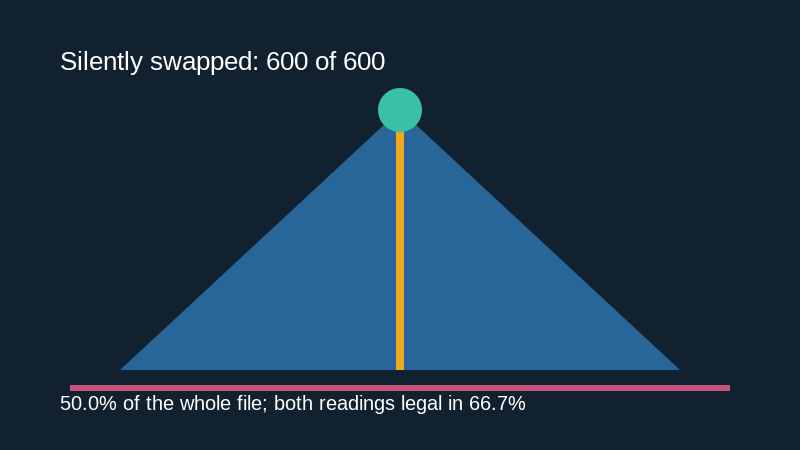
That split is the operational trap. A team reviewing the day-first run would see failures and find genuine mismatches to fix. Having quarantined the loud rows, the team could conclude that the rows that parsed cleanly were sound. In this test the surviving rows were exactly the corrupted ones. Clean parsing was not evidence of correctness. It was the mechanism of corruption, available only to rows whose numbers were small enough to exchange places.
The defence is not a smarter guess about which convention a file uses, because a uniform guess will be right for one population of files and silently wrong for another. The defence is to refuse the ambiguity at the boundary: require the convention to be stated with the data, or convert dates to an unambiguous form such as the ISO shape at the earliest step. The measured alternative costs 50.0% of a file, silently.
How this was measured
The dates in this test were synthetic, constructed by a measurement script rather than taken from any real register, export, or customer system. The script generated 1,200 date strings from a single stated source convention, month first, in three constructed groups of 600 ambiguous, 300 unambiguous, and 300 ISO strings, and then applied two parsers, one matching the source convention and one reversing it. The script ran with a fixed seed of 42, so the same strings are produced on every run, and both parsers were the script's own deterministic logic, applying fixed field orders with no learning and no outside data. Nothing here is a measurement of a commercial product; no vendor date library, spreadsheet application, or platform was tested. All counts are constructed quantities and are stated as such: 1,200 constructed strings, with a silent error meaning a parsed date that differs from the date the string was constructed to represent.
Questions, answered
Why do the swapped dates pass every validation check? Because every check a validator can apply to a single date is satisfied by the swapped result. Both numbers are within the valid month range, the swapped combination is a real calendar date, and the string matches the expected slash pattern. Validation can confirm that a date is possible. It cannot confirm that a date is the one the writer meant, and in the ambiguous group, at 600 of 600 strings under the wrong parser, possibility and intent came apart.
If half the file failed loudly, would a team not notice that something was wrong? A team would notice the loud half, but the loud and silent rows have different causes. The loud rows fail because their shape or range does not fit. The silent rows succeed because their shape and range fit too well, under both readings. Fixing every loud failure would still leave all 600 swapped dates in place, filed as correct, which is why a parse success rate should never be reported as an accuracy rate for slash-formatted dates.
Summary
The Ambiguous Slash is what happens when one string honestly supports two dates and a reader quietly picks the wrong one. In this test, 66.7% of slash-formatted rows admitted both readings. A parser matching the source convention read 900 strings correctly and silently misread none, while the reversed parser silently swapped all 600 ambiguous dates, which is 50.0% of the whole file, failed loudly on the rest, and read 0 correctly. The loud failures were the safe ones. The clean parses were the corruption. Until the convention travels with the data, a successful parse of a slash date proves only that a date was produced, never that it was written.
Sources
- SmartDataAI measurement W3 (date ambiguity), batch 6, run 2026-11-23; see this batch's evidence folder for the generating script (evidence/sd_batch6_measurements.py) and its result file (evidence/sd_batch6_results.json).
- Construction note: the date strings, their three groups and the two parsers were script-built under seed 42; the measurement section above gives the complete construction account.